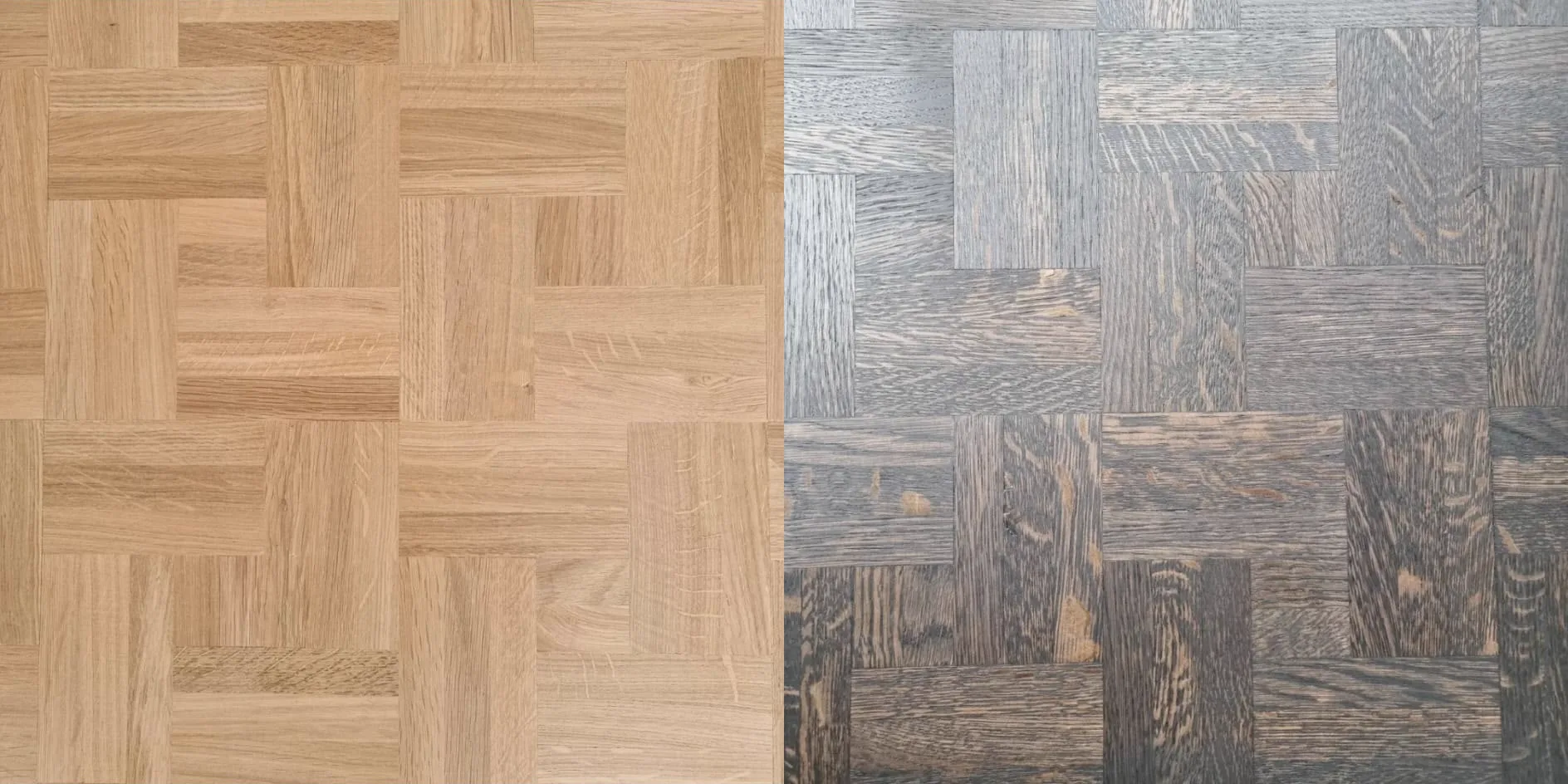
The floor did not arrive black. We made it black, after it was down.
Most dark floors come out of a box: coloured in a factory, identical in every house that orders them, chosen from a sample the size of a coaster. The floor in the photo above was built the other way round. Raw oak fingers, laid one at a time in Chipstead, on our own doorstep, then coloured on the floor itself until the client was looking at the exact black she'd been carrying around in her head. It's the best answer we've got to a question we hear a lot: what can a flooring firm actually do that a shop can't?
First, What a Finger Mosaic Is
Picture a square made of five or so slim fingers of solid oak, all running the same way. Now set the next square with its fingers running at ninety degrees, and keep alternating across the whole room. That's finger mosaic. Because the grain keeps switching direction, no two neighbouring blocks catch the light the same way, and the floor reads differently from every doorway and at every hour of the day. It was everywhere in the fifties and sixties, then vanished for half a century, and that long absence is exactly why it stops people in their tracks now.
How the Job Started
The client came to us with a clear picture and a real problem. She wanted a black floor with depth and movement, and she'd been through every pre-finished range she could find without seeing a single board that had it. Flat, uniform, lifeless: the factory blacks all looked like each other. Her first thought for the pattern was herringbone, but she asked us if there was something wilder, and when she priced up the grander weave patterns the numbers were getting uncomfortable. So we showed her finger mosaic. All the intricacy she was after, in a pattern that made sense for the room and the money, and she loved it on sight.
Why Lay It Raw?
Here's the honest comparison. A pre-finished black floor is quicker: the colour and the coating are baked on before the box is opened, and the job's done when the last board clicks in. But the colour was decided in a factory, you saw it under showroom lights, and if it's not quite the black you imagined, tough.
Laying the mosaic raw means every stage after the laying still has to happen in the house: filling, sanding, staining, sealing, each with its own drying time. It's slower and it's harder, and it's the only way to hand someone a colour they chose off their own floor. No manufacturer can do that, because no manufacturer is standing in your front room when the colour goes on. We are.
The Part Nobody Sees
Before a single finger of oak went down, the subfloor got a coat of liquid DPM, a damp proof membrane. Moisture creeping up from below is what makes glued-down blocks cup, lift and fail years later. Sealing the subfloor first is slow work that disappears completely under the finished floor, and it's the reason the finished floor stays finished.
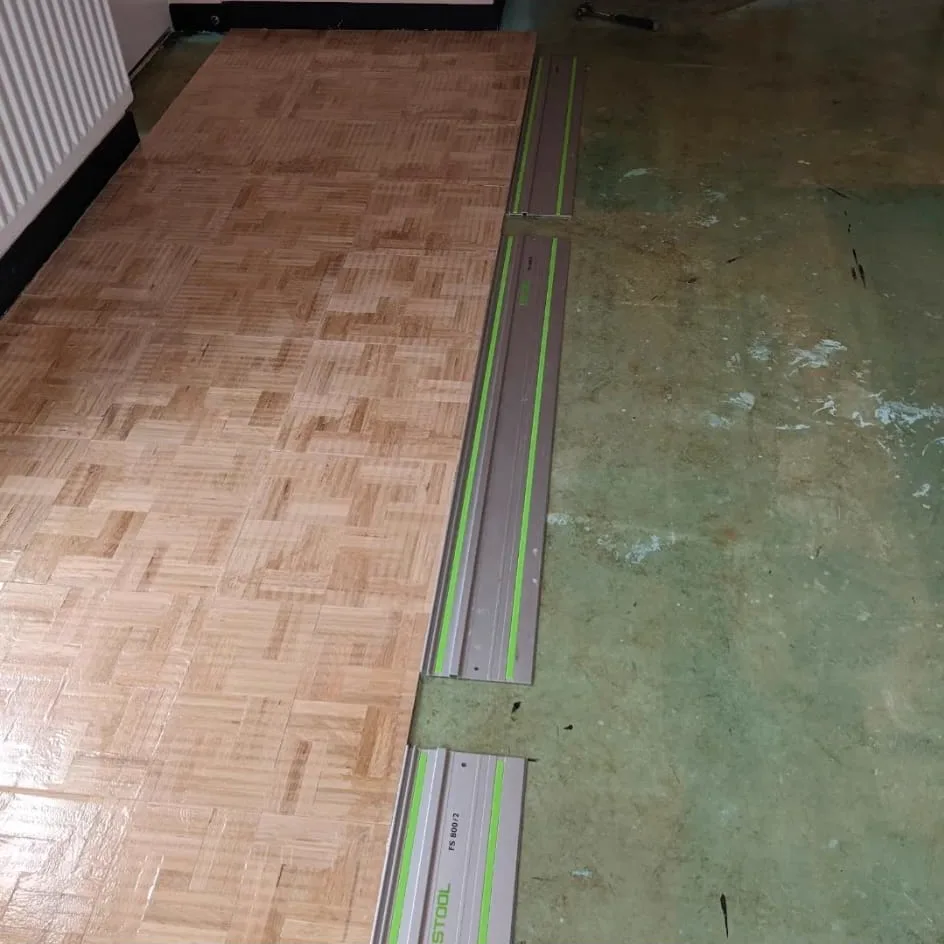
Then the laying. Every block is set into adhesive by hand, direction alternating, lines checked and re-checked, because in a pattern this busy a lazy row doesn't hide, it multiplies. Two pairs of hands, over 40 years' combined hands-on experience between them, and a floor that grows a few squares at a time.
The Resin Fill
Once the adhesive had cured, the whole floor got a resin fill. We mix clear resin with the floor's own sanding dust, so the filler is literally made of the same oak it's going into, and trowel it right across the surface. It works down into every joint between the fingers.
It looks alarming at this stage, like someone has plastered a brand-new floor. That's fine. The sanding takes back everything that isn't wanted, leaving filler only in the joints, matched by nature because it came from the floor itself. On a mosaic with this many joints, that's the difference between a stain that goes on evenly and one full of dark lines where colour has pooled.
Sanding, Patch Tests, and the Black
Then the floor went through our full three-stage sanding process, the same one every floor of ours gets, taking it from resin-covered back to clean, flat, open-grained oak ready to drink a colour evenly.
And this is where laying raw pays off. Instead of a colour chart, we put patch tests down on the floor itself: several different blacks, side by side, in her light, on her oak. She had no idea how many blacks exist until she saw them together, from soft charcoal through to deep ebony. She picked her black off her own boards, and we stained and sealed the whole floor to match, on site. If you're weighing up blacks for your own room, you can try them on a photo of your own floor with our floor visualiser before a single patch test goes down.
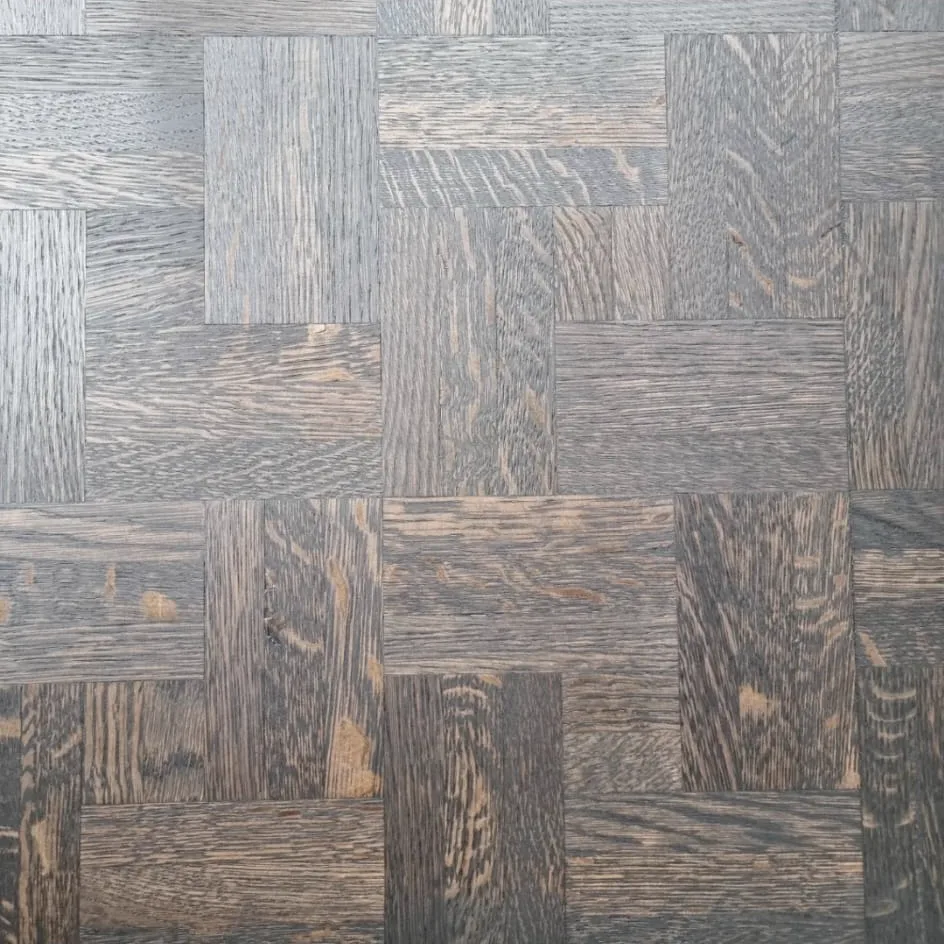
Look closely at that photo. The stain hasn't buried the wood; the alternating grain still catches the light block by block, just in a darker key. That's the depth she couldn't find in a box.
Borders, Patterns and the Rest of the Family
Finger mosaic is one branch of a bigger craft. We fit new pattern floors, herringbone and chevron chief among them, always glued down over a properly prepared subfloor, and we restore existing parquet that other trades would rip out. The fiddliest work is often the border: in Fulham we brought back a walnut herringbone with a double inlay border that curves around a kitchen island, worked by machine and by hand until the detail came up crisp. Pattern work takes the same patience this black mosaic did, and it's some of the most satisfying flooring there is.
Questions We Get Asked About Floors Like This
What is a finger mosaic parquet floor?
It's a parquet pattern made of small fingers of solid oak, grouped into square blocks that alternate direction across the floor. Because the grain keeps changing direction, every block takes the light differently, and the floor shifts in character as you walk through the room or as the day moves on. It was a hugely popular pattern in the mid-century, then fell out of fashion for decades, which is exactly why it looks so fresh now.
Why lay a floor raw instead of buying pre-finished black parquet?
A pre-finished board is coloured in a factory, so you get the colour the factory chose, seen in a showroom under showroom lights. A raw floor is coloured in your house, on your actual floor, in your actual light, and you approve the colour from patch tests before we commit to the whole thing. It also means the floor can be sanded and re-coloured in the future, so you're never stuck with one decision for life.
Can you stain an existing parquet floor black?
Yes. An existing parquet floor in sound condition can be sanded back to bare wood and stained, the same way a new one can. We always lay patch tests first, because black isn't one colour: there's a real range from soft charcoal through to deep ebony, and the same stain reads differently on different timbers. You choose from the real thing on your own floor, not from a chart.
Does a black floor show more dust and marks?
We'll be honest: yes, a very dark floor shows dust, pet hair and fine scratches more readily than a mid-tone, and anyone who tells you otherwise is selling something. If your home is busy with kids and dogs, we'll say so at the site visit and help you weigh it up. Plenty of our clients decide the look is worth a bit more of the vacuum, and some land on a softer charcoal instead.
If You Want a Floor Nobody Else Has
This floor exists because a client refused to settle for the blacks in the boxes, and because there's still a firm that will lay a floor raw and colour it in the room, block by block, with one of us on every job. If you've got a colour in your head that no showroom can show you, that's exactly the conversation to have with us.
Call us: 020 3131 0122
Email: [email protected]
Or book a free site visit and we'll bring the patch tests to your floor, not the other way round.