Blocks, Boards & Gaps
Wood Floor Repairs in London
Loose and hollow blocks re-fixed, split boards replaced with reclaimed timber, gaps filled, and the floor made good before it is sanded. Repair work is carried out as part of our sanding and installation jobs. Watch one of our directors fix a rocking parquet block below.
★★★★★ 4.9 from 53 Google reviews
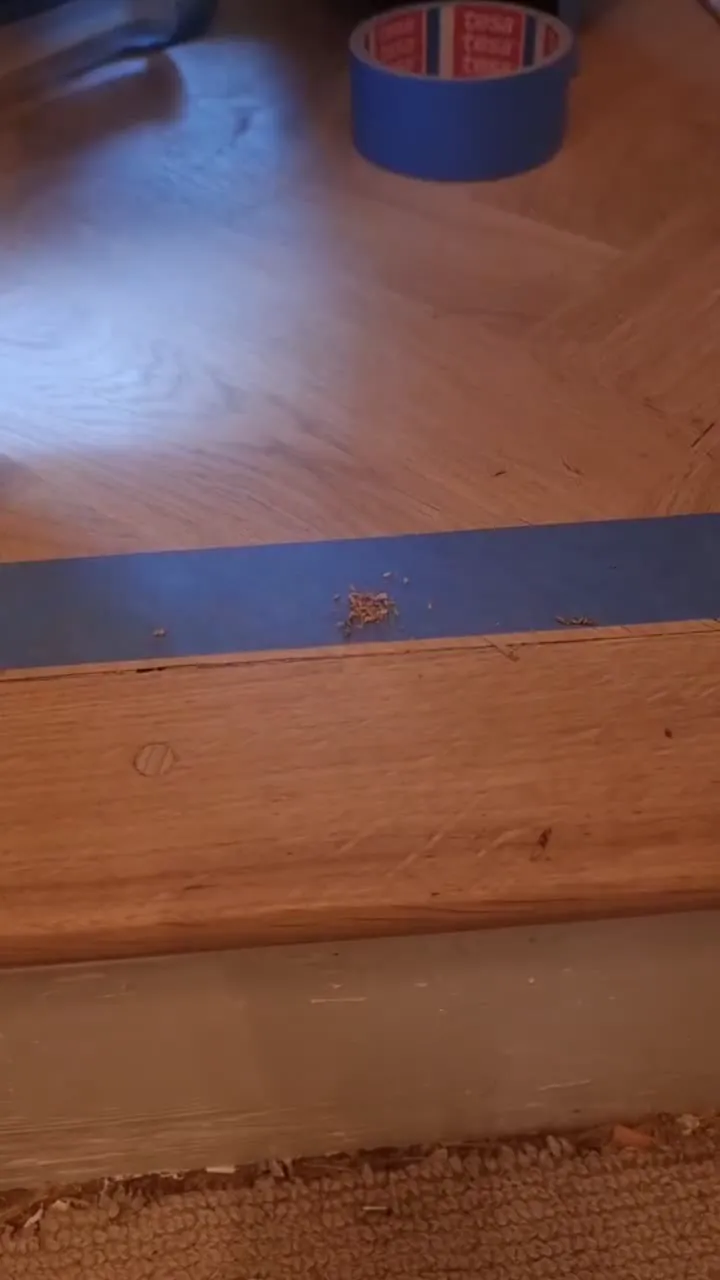
A hollow block re-fixed in place: drill a small hole, syringe adhesive underneath, wipe it clean. No need to lift the floor.
Home · Wood Floor Repairs
The Most Common Call
Loose, Hollow and Rocking Blocks
Original parquet was stuck down with bitumen, and bitumen has a shelf life. After several decades it dries out, goes brittle and lets go, so blocks start to lift, rock underfoot or sound hollow when you walk over them. It is the single most common repair we get called out for, and it is rarely as serious as it feels.
You do not need to lift a whole floor for a handful of loose blocks. Where a block has come right up, we lift it, clean the old adhesive off the timber and the subfloor, and re-bed it in modern parquet adhesive. Where a block is still in place but has gone hollow, we can fix it without disturbing the pattern at all: a small hole drilled through it, adhesive syringed underneath to fill the void, the block weighted down and the surface wiped clean. That is the job in the video at the top of this page.
Matched, Not Patched
Split, Cracked and Missing Boards
Boards split along the grain, crack where an old fixing has worked through, or go missing entirely where a plumber or an electrician has been under the floor and not put things back. We cut out the damaged boards and replace them with reclaimed timber of the same age, species and size, so the repair carries the same colour and character as everything around it.
The same matched-timber approach covers fireplace hearths: when an old hearth is coming out, we remove it and patch the gap with reclaimed boards or blocks that carry the same age as the floor around them. One thing we're always straight about: for a perfect match the whole floor is then sanded and finished as one, which is why hearth work happens as part of a full sanding project. Patch a hearth without sanding the room and the repair will always show.
The reason we use reclaimed wood rather than new is simple: new timber never blends. It sits brighter, takes finish differently and always announces itself, even after a sand. Matched reclaimed boards, sanded and finished together with the rest of the floor, vanish. There is more on how we do this on pine floors in our write-up on repairing pine floors with reclaimed boards.
Filled to Move
Gaps Between the Boards
Old floors gap. Timber shrinks as it dries over the years, and by the time a Victorian pine floor reaches you there can be a finger-width between some boards. We close them with a flexible filler that moves with the timber through the seasons, expanding and contracting as the boards do, rather than a hard resin that would crack straight back out of a floor that is still alive underneath.
That distinction matters, and it is not the same on every floor. On glued-down parquet, where the blocks cannot move, resin is exactly right. On suspended boards it is the wrong tool. We have written up the whole argument in flexible filler versus resin for gap filling, because getting it wrong is one of the more common mistakes we are called in to put right.
Made Sound Again
Water Damage, Cupping and Squeaks
A leak, a spill left too long or a radiator that has wept for years leaves its mark. Boards cup as they swell, blacken where the water sat, and sometimes go soft. Where a board has dried back out, cupping can usually be sanded flat once the moisture has gone. Where it has gone black or spongy, it has gone too far and is better cut out and replaced with matched timber than sanded over and forgotten.
Squeaks get dealt with at the same time. A squeak is movement, a board rubbing against a fixing or a joist that has loosened over time. We re-secure the boards and fix down properly into the joist where an old nail has stopped holding. None of this is glamorous, but a floor that is quiet, flat and solid underfoot is the whole point of getting the repairs right before anything else happens.
No Obligation
Not sure what your floor needs? One of us will come and look, tell you straight, and leave you a fixed price.
Book a Free Site VisitThe Right Order
Making Good Before a Sand
Repairs come first, always. Loose blocks fixed, split boards swapped, gaps closed, squeaks silenced, and only then does the sanding start. Do it the other way round and you are sanding a floor that is still moving, then patching afterwards and hoping it blends. It never quite does.
Once the floor is sound, the whole thing gets our three-stage sand and finish as a single surface, so the old wood and the new repairs read as one floor rather than a floor with visible mends in it. You can see how that final stage works on our floor sanding page, and for pattern floors specifically on the parquet restoration page, where re-fixing loose blocks is the starting point of nearly every job.
No Surprises
What Every Repair Quote Includes
- A free site visit and an honest verdict on what actually needs fixing
- Loose and hollow blocks re-fixed, by lifting and re-bedding or by syringe injection
- Split and missing boards replaced with matched reclaimed timber, not new wood
- Gaps filled with a flexible filler that moves with the floor through the seasons
- Squeaks and loose fixings secured down into the joists
- Repairs completed before any three-stage sand, so old and new read as one
- A fixed written quote, with no obligation
Straight Answers
Repair Questions, Answered
Can you fix a few loose blocks without redoing the whole floor?
Do I need a full sand after repairs?
Can you match old boards and blocks?
My floor squeaks, can that be fixed?
Can you fix water-damaged boards?
Do repairs have to be sanded to blend in?
From Our Google Reviews
"Absolutely fantastic! Cannot recommend Dean and team more highly. They were fast and easy to communicate with, and fitted us into their busy schedule so that we could get the job done before our baby was due, which we hugely appreciated. They did an amazing job on our wooden floor which had been damaged by a major leak, and the whole team was courteous and lovely to have around. The floor looks amazing - we can’t stop admiring it! They are clearly passionate about their trade and that comes across in every element of what they do. Thank you!"
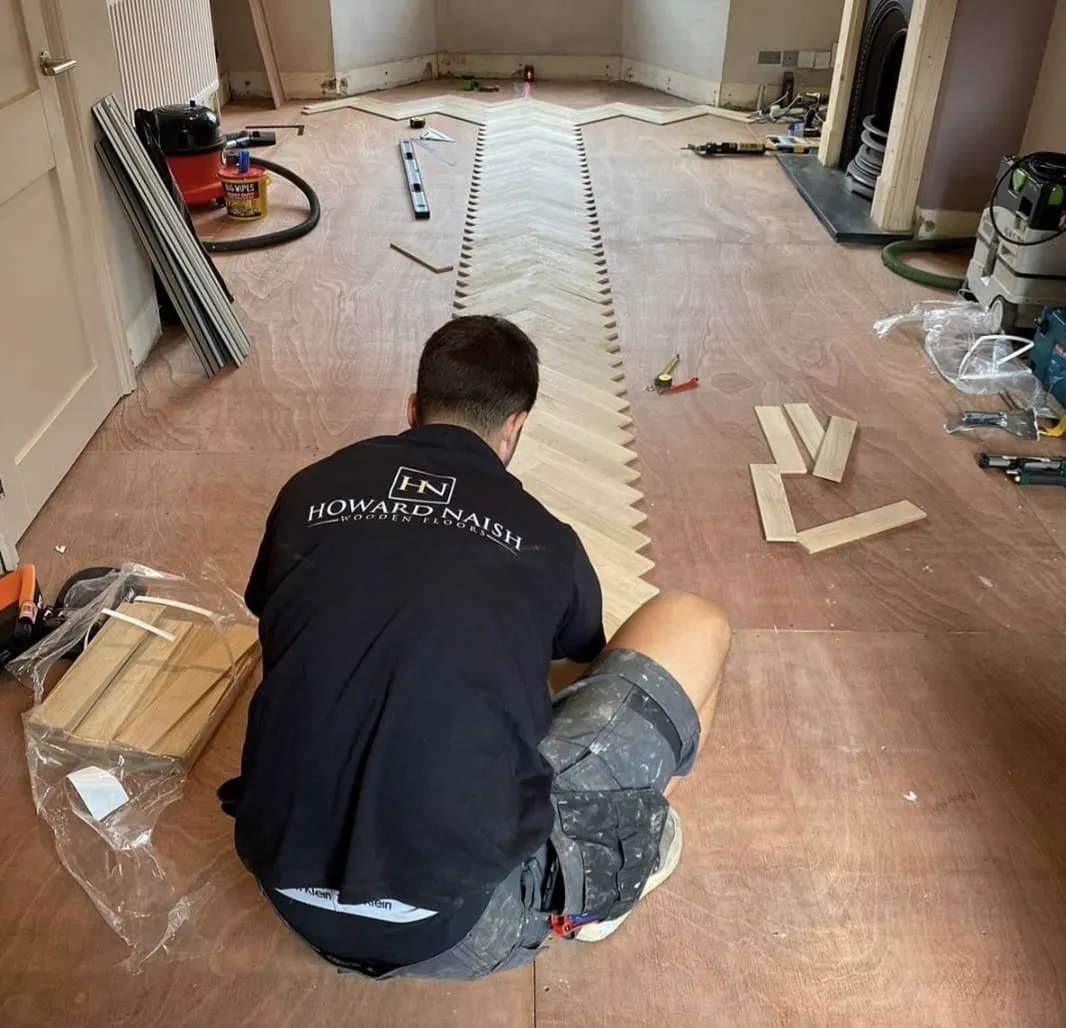
Luke at work. One of us, Dean or Luke, is on every job, repairs included.
Thirty Seconds, Five Boxes
Tell Us About the Damage
Leave your details and we'll ring you back to arrange your free site visit.
We're booking about three months ahead at the moment, and a deposit holds your place in the queue. Dates tight? Ring us anyway, cancellations happen and smaller jobs can often be slotted in.
Every job is backed by the Howard Naish Workmanship Promise: 2 years on installation, 12 months on sanding and refinishing. If our work fails, we fix it.
We repair floors right across South London, including: Balham, Clapham, Dulwich, Wimbledon, Southfields, Tooting, Brixton, Streatham Hill, Crystal Palace, Gipsy Hill, Kensington, Purley, Sutton and Camberwell.
Free Quote, No Obligation
Put the Floor Right
A free site visit, an honest verdict on what your floor actually needs, and a fixed quote.
020 3131 0122