It's the first question everyone wants answered and the one most flooring websites dance around. So here are our actual numbers, what moves them up or down, and a worked example, so you can budget properly before anyone sets foot in your house.
One thing first: this guide covers sanding and refinishing what you already own; if you're pricing a brand-new floor, the numbers live in our installation cost guide. And a warning that applies to both: any firm that gives you a fixed price without seeing the floor is guessing, and you'll find out whose guess it was halfway through the job. The honest answer is always a range until the floor's been looked at. Our site visits are free and the written quote is fixed and given in writing, so you're never guessing for long.
The Headline Numbers
As a guide, excluding VAT:
- Hardwood floors (oak, parquet, engineered): £30 to £50 per square metre for the full three-stage sand and finish. The range is wide because size matters: large areas earn a discount, so a whole house lands nearer the bottom of it than a single room.
- Original pine boards: £40 to £60 per square metre. Pine can sit at the top of the range because old boards bring old problems: paint down the edges, nail heads to punch, more repairs, and softer timber that needs more careful machine work.
- Changing the colour: add £8 to £10 per square metre for staining, patch-tested free on your own boards first.
Those rates include the finish: three coats for lacquer, two coats for oil. They're the same rates wherever we're working, from Balham to Kensington. A postcode doesn't change what the floor needs.
Parquet Restoration
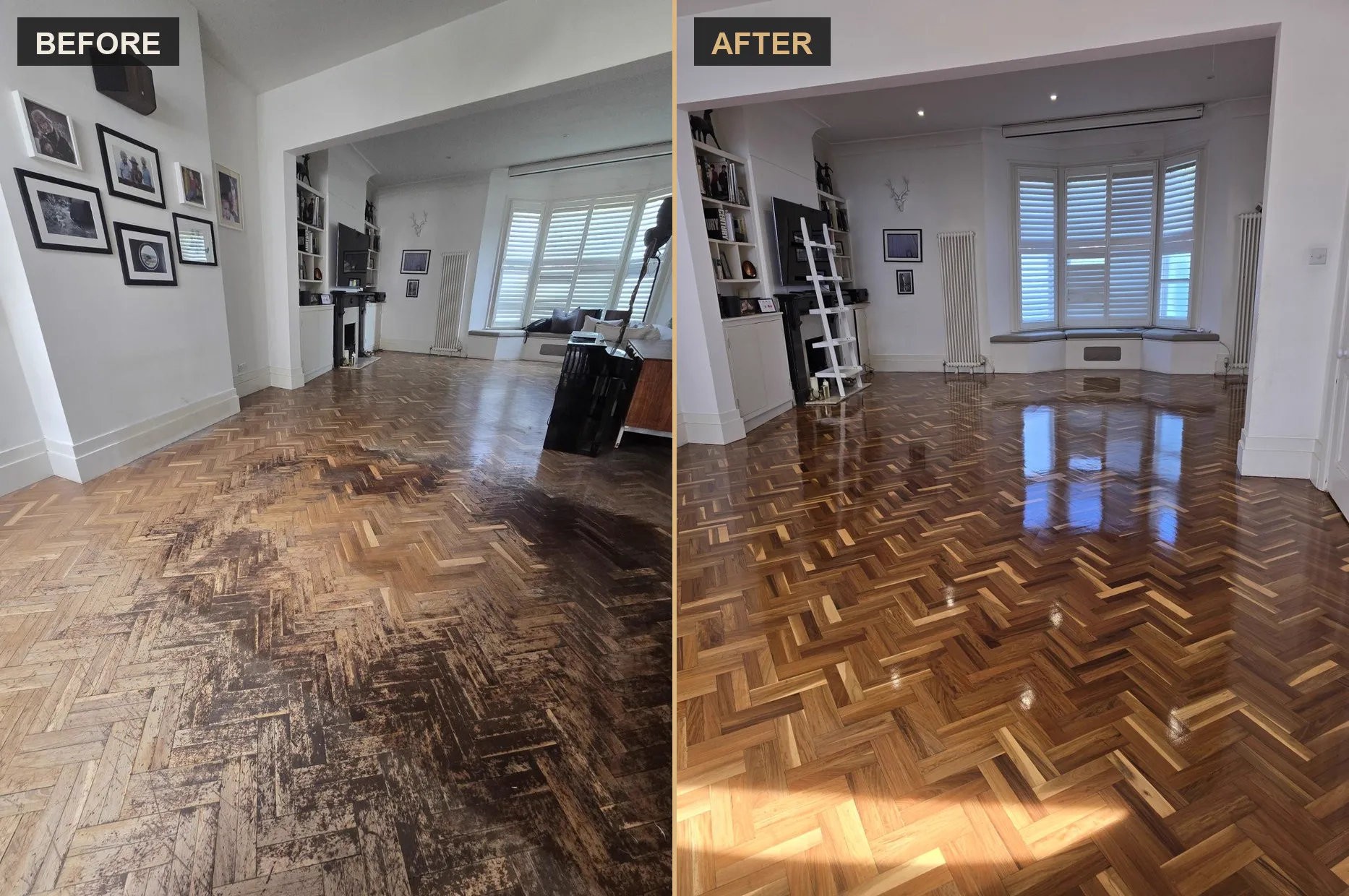
Parquet guides at £30 to £45 per square metre, sanded and finished. Old blocks bring their own jobs: bitumen adhesive creeping up the joints wants more first-stage work, and any loose or missing blocks are re-stuck or replaced from reclaimed stock before the sanding starts, priced as their own line on the quote (small repairs start from £150 a visit). The work itself is covered properly on our parquet restoration page.
Estimated Guide Prices at a Glance
| Job | Guide price (ex. VAT) |
|---|---|
| Hardwood / oak floor sanding & finishing | £30-50 / m² |
| Pine / period floorboard sanding & finishing | £40-60 / m² |
| Colour staining (add-on) | £8-10 / m² |
| Gap filling | £8-12 / m² |
| New floor fitting, straight plank (labour) | £30-50 / m² |
| Herringbone / parquet fitting (labour) | £40-70 / m² |
| Parquet restoration (sand & refinish) | £30-45 / m² |
| Small repairs | from £150 a visit |
| Minimum job charge | £500 |
Guide estimates only, shown excluding VAT. Every floor is different, so the final price depends on its condition, size and finish. Very small jobs are charged at a minimum of £500 (about a day's work); larger floors are priced per square metre as above. You get a free site visit and a fixed written quote.
What Moves the Price
- Size. The bigger the floor, the better the rate. Setting up, travel and machinery cost the same for one room as for six, so on large areas the per-metre price drops and we pass that on as a discount.
- The finish specification. A standard domestic lacquer or oil is included in the guide rates. Step up to a commercial-strength two-pack lacquer, the sort we use on pubs and school halls, and the materials cost more, so the rate rises with it.
- Condition. A floor under decades of carpet is usually easy. A floor under layers of paint, or parquet with old bitumen creeping up the joints, needs more first-stage work.
- Repairs. Split or missing boards are replaced with reclaimed timber before sanding starts, and they're priced up front, on the quote, not discovered halfway through.
- Gap filling. Filling with flexible filler adds a little; it's priced per job and it makes a real difference in a draughty pine room.
- Edges and shape. A big open room is mostly machine work. Hallways, stairs and rooms full of alcoves are mostly edge work, which is slower per metre.
- Waste and parking. Small lines on our quotes, shown separately so nothing hides inside the sanding rate. Waste clearance is optional (no charge if you'd rather deal with it yourself) and parking is only charged at cost, nothing if you can sort a space.
How Long Does Floor Sanding Take?
Time matters as much as money when your home is upside down, so here is the honest shape of a job. A single room is usually a two-day visit: the three-stage sand and the first coats on day one, the final coat on day two once everything beneath it has hardened. A whole ground floor with the rooms cleared is aimed at inside a week, and a full house is quoted with its own timetable so you know which rooms come back to you when.
The thing that moves a timetable most is furniture. If a floor can't be emptied, we work it in two halves: sand and finish one half, wait for it to dry and harden, move everything across, then do the other half. Every one of those waits is real drying time, so a furnished job can run to nearly double the length of an empty one. It's no problem, we plan around furniture all the time, but if you can empty the rooms before we arrive you'll get your house back sooner and the job costs less of your patience.
After the last coat, a lacquered floor takes gentle sock-footed traffic the next morning and furniture after a day or two, felt pads on. Oiled floors like a little longer before the heavy stuff goes back. Either way, keep rugs off for a couple of weeks while the finish reaches full hardness; that patience is what the years of wear come from. If a deadline matters, say so at the site visit and we will build the job around it.
What Your Room Probably Costs
Before the detailed examples, here is the quick-scan version. Every floor is different, wear, timber, repairs and finish all move the number, so treat these as rough guides for budgeting, not price tags. All figures include VAT, before any stain, gap filling or repairs, which always appear as their own lines on the quote.
- A single bedroom (10 to 14 m²): usually £600 to £850. Our minimum job charge of £500 plus VAT means very small rooms don't shrink much below this; the machinery, setup and finish are the same whatever the size.
- A living room (18 to 25 m²): usually £1,100 to £1,700 depending on the timber and the finish you choose.
- Two knocked-through receptions (28 to 36 m²): usually £1,700 to £2,600. This is the classic Victorian terrace job.
- A whole ground floor (50 to 70 m²): usually £2,600 to £4,000, with the size discount doing real work at this end.
If your room isn't on that list, or your floor looks rougher than anything described here, don't rule yourself out. Floors that look beyond saving usually aren't, and the real number comes from a free site visit, not a list on a web page. It's often kinder than you expect.
What Does Stair Sanding Cost?
Stairs are priced as their own job, because stairs are hand work. No machine rides a staircase: it's handheld sanders, step by step, and unlike our floor machines that work isn't dust-free, so we sheet off the stairwell and tell you honestly before we start. As a guide, a full pine staircase with treads and risers both sanded and finished comes in around £1,200 plus VAT. Treads only, with the risers keyed up ready for your decorator's paint, is around £500 plus VAT. An oak flight is around £750 plus VAT, since there's no old paint to fight on oak. Winders, spindles and paint history all move the number, and our stair sanding page covers the whole job.
Three Worked Examples
A 25 square metre living room on an oak floor, sanded and finished, with a colour change:
- Three-stage sand and finish: 25 m² at £38 = £950
- Stain, patch-tested first: 25 m² at £10 = £250
- Waste clearance: £50 (optional)
- Parking: £50 (nothing if you can provide a space)
That's £1,300 net, £260 VAT, £1,560 all in. Skip the stain and provide parking, and the same room lands around £1,200 including VAT. Your own quote will show whole-job figures exactly like this, each line its own number, so you can take things out or leave them in and see precisely what changes.
And here is a second, this time on period pine. Two connected rooms of Victorian boards, 30 square metres in all, with the gaps filled and a couple of boards replaced:
- Three-stage sand and finish: 30 m² at £40 = £1,200
- Gap filling with flexible filler: 30 m² at £10 = £300
- Board repairs in reclaimed Victorian pine: £150
- Waste clearance: £50 (optional)
- Parking: £50 (nothing if you can provide a space)
That's £1,750 net, £350 VAT, £2,100 all in, for two rooms that were draughty, gappy and paint-splattered on the Monday and look like the reason you bought the house by the end of the week.
And one more at the bigger end, because this is where the size discount starts working for you. A whole ground floor on engineered oak, around 65 square metres through a hallway, front room and kitchen-diner, finished with a commercial-strength lacquer because it all takes heavy traffic:
- Three-stage sand and finish, commercial-strength lacquer included: £2,600
- Waste clearance: £50 (optional)
- Parking: estimated £50, tallied up at the end of the job (nothing if you can provide a space)
That's £2,650 net, £530 VAT, £3,180 all in. Look at the per-metre maths hiding in there: a floor this size earns a rate at the lower end of the range, and the commercial-strength lacquer is inside the number, not an extra bolted on later. A 65 metre floor doesn't cost five times a 13 metre bedroom; it costs closer to three times.
And treat all three examples as a guide, not a bill. The oak room is priced at the middle of the range, and plenty of floors come in under it: if the site visit shows us boards in good nick, an old finish that comes off without a fight and no repairs needed, or a larger area earning its discount, the price can be significantly lower. The numbers are here so you can budget without guessing, not to scare you off before we've even seen the floor. The site visit costs nothing, the quote it produces is fixed in writing, and the only surprise left is sometimes a pleasant one.
Why the Cheapest Quote Is Rarely the Cheap Option
Don't just take our word on any of this, either: independent cost guides such as Checkatrade's floor sanding cost guide are a useful cross-check when you're comparing quotes, and we're happy to be compared.
Floor sanding quotes in London vary wildly, and the gap is usually in what's quietly missing. Whoever you use, ask these four questions and watch the cheap quotes wobble:
- How many sanding stages? One coarse pass leaves a floor that looks fine for a month. Ours is a three-stage process, every time.
- How many coats of finish? Three for lacquer, two for oil is the proper spec. One coat is a false economy you'll pay to put right.
- Are repairs and gap filling in the price, or "extras" waiting to happen?
- Who's actually doing the work? With us it's Dean or Luke, the partners, on every job. Not a gang you've never met.
DIY Sanding or Us? The Honest Maths
You can hire a drum sander for a weekend, and plenty of people do. The hire shops charge roughly £40 to £70 a day for the machine, the edging sander is extra, and the abrasives are where the bill quietly grows: expect £150 to £250 in kit before you've bought a drop of finish. Those are hire-market figures, not ours.
The honest trade view is that hire drum sanders are hard on floors. They chatter, they gouge if you pause mid-pass, and a heavy-handed weekend can take millimetres off boards that only have so many sands in them. A fair share of our work is rescuing DIY sands, and the rescue costs more than the original job would have, because the dips have to come out before the proper work can start. If you're handy and the room doesn't matter much, hire away. If it's the floor everyone sees, the gap between the hire-kit money and a professional job is smaller than it first looks.
Sometimes the Answer Is Much Cheaper
Not every tired floor needs sanding at all. Oiled floors especially are designed to be fed, not stripped: a deep clean, a buff and a fresh coat of oil costs a fraction of a full restoration, and we've written up a real pub floor we revived exactly that way. If that's all your floor needs, that's what we'll quote. Every floor only has so many sands in it, and we don't spend one lightly.
What a Howard Naish Quote Actually Looks Like
Since this whole page is about numbers, here is how they arrive when we quote you. Whole-job figures, one line each, no per-metre rates to reverse-engineer. Waste clearance shown separately and optional: dispose of it yourself and pay nothing. Parking estimated at £50, tallied up honestly at the end of the job, and free if you can provide a space. Your finish choice is free, proven with patch tests on your own boards before the final coats, with lacquer applied as three coats and oil as two. On most quotes you'll also see an optional commercial-strength lacquer upgrade, recommended for kitchens and areas with heavy foot traffic, typically £100 to £200 depending on floor size. Nothing appears on your invoice that wasn't on your quote, except a tallied parking figure you already knew was coming.
Cost Questions, Answered Straight
Do you charge for the site visit or the quote?
Do your prices include VAT?
Do you take a deposit?
Why do you price per square metre but quote one figure?
Is it cheaper if my floor doesn't actually need a full sand?
How much does it cost to sand and varnish floorboards?
Why do national cost guides quote lower rates than yours?
Do you charge a day rate?
Measure your room, take the ranges above, and you've got an honest budget. Then let us look at the floor and turn it into a fixed number.
Call us: 020 3131 0122
Email: [email protected]
Or book a free site visit. Fixed written quote, and the price we quote is the price you pay.