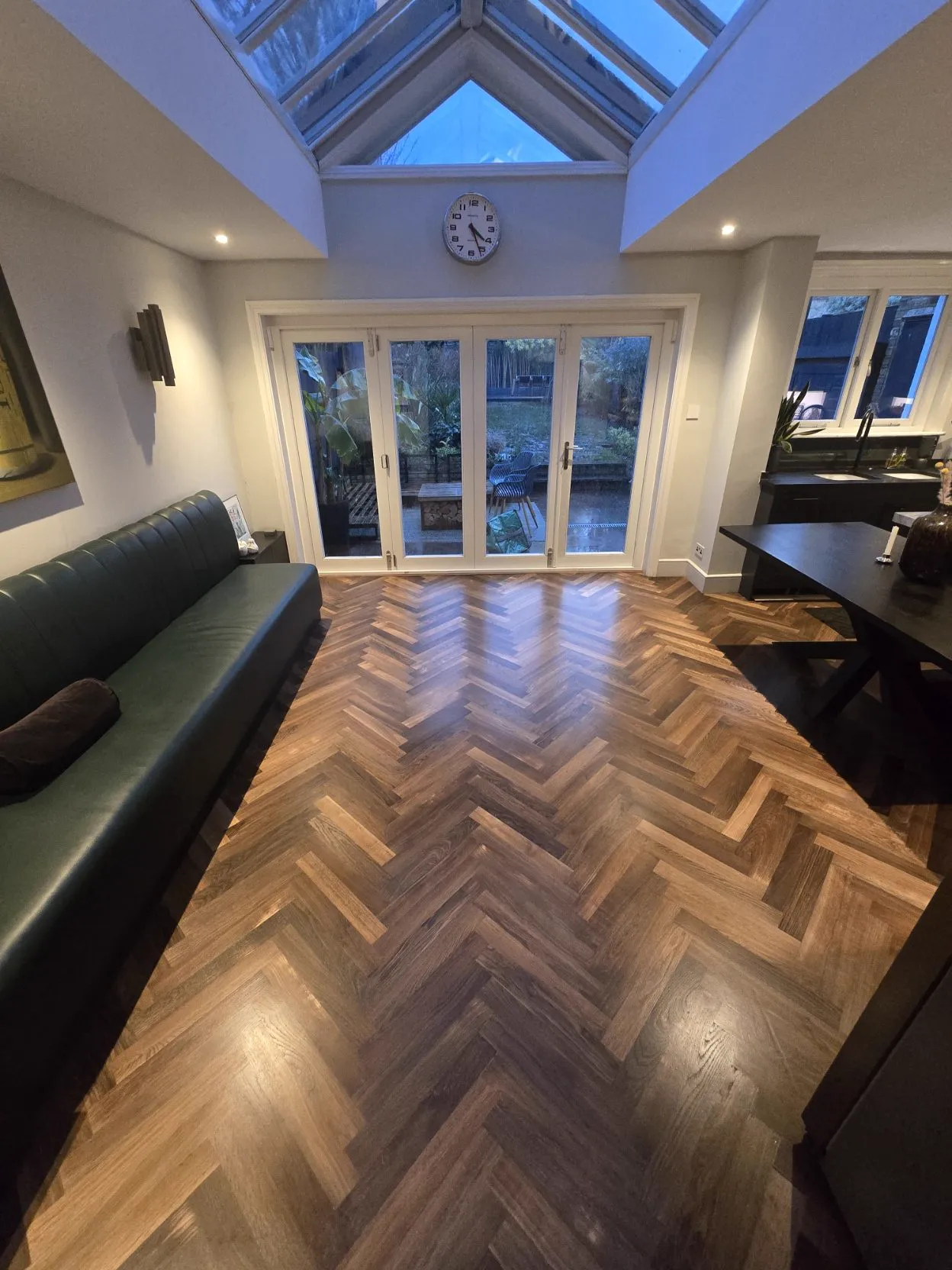
The Decision Every Floor Ends With
Oil or Lacquer: Choosing Your Wood Floor Finish
Every sanded or new floor ends with this choice. We apply both every week, so here's the honest difference, not the sales version.
★★★★★ 4.9 from 53 Google reviews
Home · Wood Floor Finishes
Two Philosophies, One Floor
One Lives On the Wood. One Lives In It.
Lacquer (you may know it as lacquer) sits on top of the timber as a hard, protective skin. We apply it as three coats. It shrugs off daily life, heels, chairs, dogs, spilt drinks, and it needs almost nothing from you beyond sensible cleaning. Its honest weakness: when it finally wears through, there's no patching it invisibly, the floor wants sanding again. The water-based lacquers we mostly use are low odour and let the wood keep its natural colour rather than yellowing it.
Oil soaks into the timber and hardens inside it. We apply it as two coats. The wood looks and feels closer to bare timber, matt, warm, touchable, and scratches tend to whisper rather than shout. Its honest demand: it wants feeding every year or two. In exchange, you can top it up and repair worn patches without a machine ever coming back into the house. The pub floor in this real job of ours was revived exactly that way, no sanding at all.
One of ours: a coat of lacquer going down on a freshly sanded floor.
The Honest Shorthand
Choose By How You Live, Not How It Looks On Day One
Both finishes look beautiful the week they go on. The difference shows in year three. So we ask about your life, not your taste: kids and dogs thundering through a hallway usually point to lacquer's toughness. A living room where you want the timber itself to be the star, and you don't mind an afternoon of maintenance every year or so, points to oil. Rental property? Lacquer, almost always: tenants don't feed floors.
- Toughest against daily wear: lacquer, three coats
- Most natural look and feel underfoot: oil, two coats
- Repairable without re-sanding: oil
- Lowest ongoing effort: lacquer
- Hard-working commercial spaces: commercial-strength two-pack lacquer, the spec we use on pubs and school halls
Whichever way you lean, nothing is committed from a chart. You choose from real samples, included in the price, and we confirm with a patch test on your own boards before the final coats go on, the same way we handle colour.
And if what's bothering you is an old pine floor that's gone orange, the finish alone can fix that, no stain involved: read how we take the orange out of pine.
Keeping It Beautiful
The Finish Is Only Half the Story. Care Is the Other Half.
Every finish we apply comes with plain instructions for looking after it: what to clean with, what never to use, and when it will want attention. The right care products, the same ones we use on our own jobs, are in our shop. A floor that gets the right soap and an occasional feed will outlast one that gets supermarket spray and neglect by years, whatever the finish.
And this page's advice works the other way too: if your existing floor is looking tired, the finish might only need topping up, not sanding off. That's a much smaller bill, and we'll tell you straight on the free site visit.
Straight Answers
Finish Questions, Answered
Can I change from oil to lacquer, or the other way round?
Which finish lasts longer?
Can a worn lacquered floor be re-coated without sanding?
Does the choice change the price of my sand?
What would you put on your own floors?
From Our Google Reviews
"Luke came and refurbished our old Victorian floor boards and did a great job. He produced just the light pine colour (finished with lacquer) we were after and did it in a very timely manor. We were very pleased and highly recommend him to anyone."

Dean on the road. One of us, Dean or Luke, is on every job, and the finish goes down under our own eyes.
Thirty Seconds, Five Boxes
Not Sure Which Way to Go?
Leave your details and we'll ring you back, samples in hand.
We're booking about three months ahead at the moment, and a deposit holds your place in the queue. Dates tight? Ring us anyway, cancellations happen and smaller jobs can often be slotted in.
Every job is backed by the Howard Naish Workmanship Promise: 2 years on installation, 12 months on sanding and refinishing. If our work fails, we fix it.
Whichever finish you choose, we work across South London: Balham, Clapham, Dulwich, Wimbledon, Southfields, Tooting, Brixton, Streatham Hill, Crystal Palace, Gipsy Hill, Kensington, Purley, Sutton and Camberwell.
Free Quote, No Obligation
See Both Finishes On Real Wood
Samples in your hands, a patch test on your own boards, and the right answer for how you live.
020 3131 0122