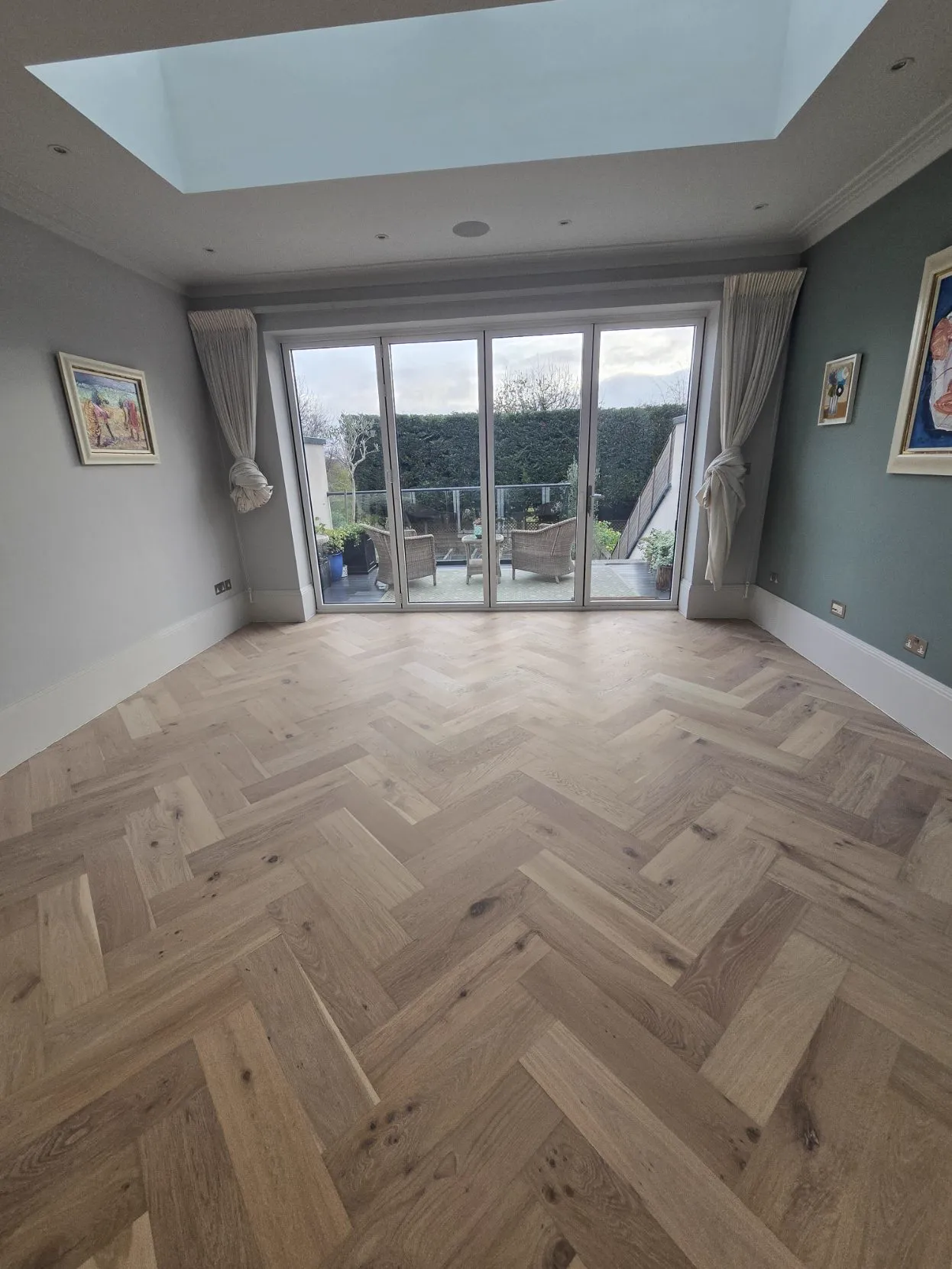
Always Glue-Down
Herringbone and Parquet Floor Fitting in London
Herringbone, chevron and parquet, set out on a laser line and glued block by block by the same two partners who priced it.
★★★★★ 4.9 from 53 Google reviews
Home · Herringbone Fitting London
Two Patterns, Often Confused
Herringbone or Chevron?
They get mixed up constantly, and the difference is simple. Herringbone is rectangular blocks with square ends, laid at right angles to each other so the pattern steps in a zigzag: the classic parquet look, woven and traditional. Chevron has the end of every board cut on an angle, so the rows meet in a continuous point and the whole floor runs like arrows down the room: sharper, bolder, more deliberate.
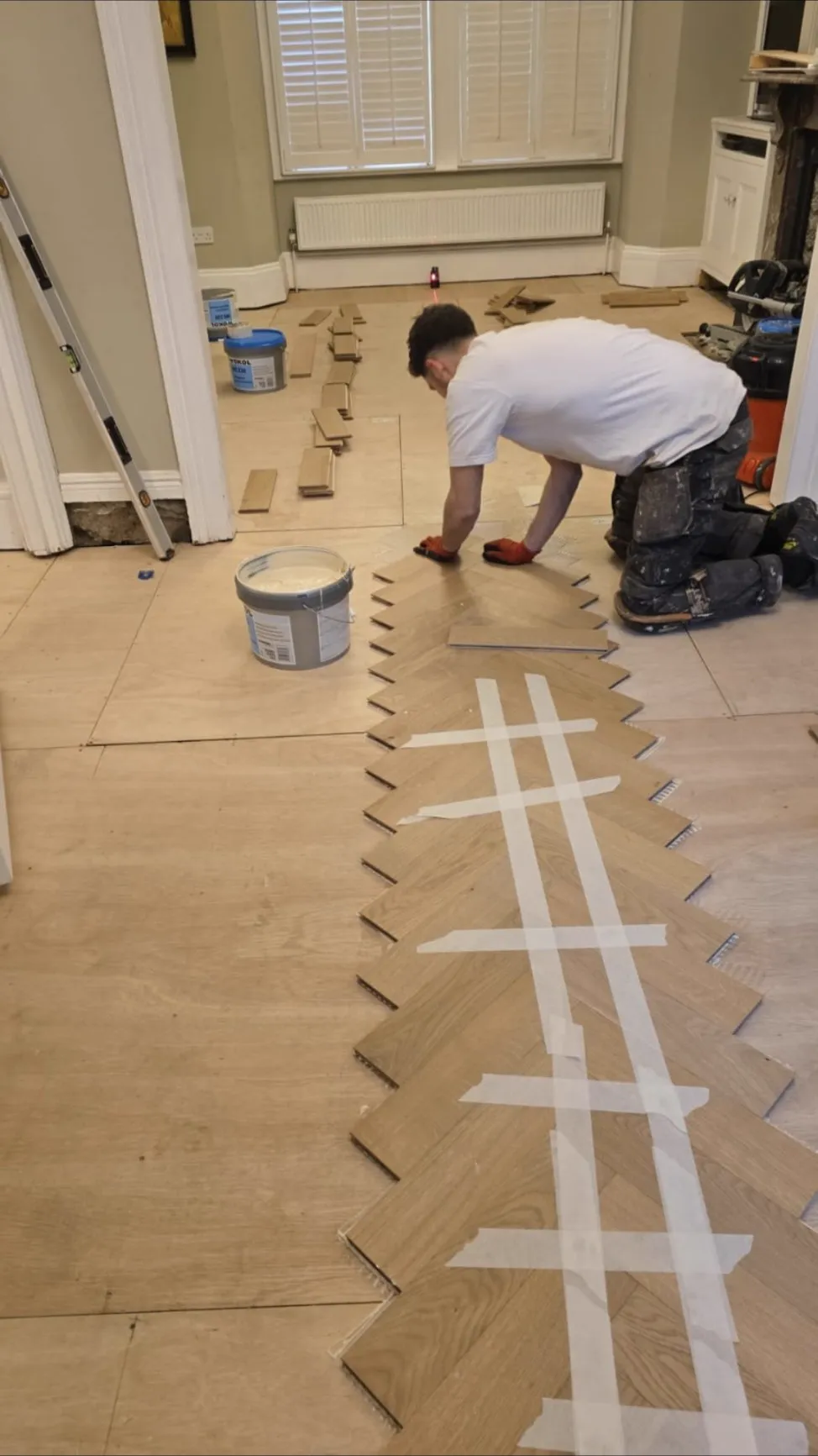
Neither is better. Herringbone forgives a busy room and sits naturally in period houses; chevron rewards a cleaner scheme and makes a statement of the floor itself. That's Luke in the photo, setting the centre spine of a herringbone on a laser line, because the whole pattern hangs off that first row being dead straight.
- Herringbone: square-ended blocks, zigzag steps, period feel
- Chevron: angle-cut ends, continuous points, bolder and more modern
- Both set out from the centre of the room, never from a wall
- Both always fitted glue-down, no exceptions
The House Rule
Pattern Floors Are Always Glue-Down
Every herringbone, chevron and parquet floor we fit is glued: each block bonded directly to the subfloor with a flexible wood adhesive. Not floated on underlay, not clicked together. Glued.
Here's why. A glued block is connected to the building, so the floor feels solid underfoot: no bounce, no hollow drum sound when you walk across it, no seasonal movement slowly working the pattern apart. Click-system herringbone products exist and they are quicker to fit, which is exactly why some fitters push them. We won't fit them. A floated pattern floor never feels like the real thing, the joints are the first part to fail, and by the time it fails the fitter is long gone.
Glue-down is slower, more careful work: the adhesive is trowelled in sections, each block is placed and tapped up tight, and the setting out is checked constantly so the pattern lands symmetrically at the walls. That is the work you are paying for, and it's the difference between a floor that looks like herringbone and one that is herringbone.
If the blocks arrive unfinished, we then sand the whole floor flat as one surface and finish it in oil or lacquer on site, so every joint is level and the sheen is even wall to wall.
The Details That Finish It
Block Sizes, Borders and Inlays
Block size changes the character of the floor more than most people expect. Traditional parquet blocks are small, roughly brick-sized, and they make a room feel busy, handmade and period-correct. Modern engineered herringbone comes in much larger formats, and the bigger the block, the calmer and more contemporary the floor reads. Small rooms carry small blocks; big open rooms need bigger blocks or the pattern turns fussy.
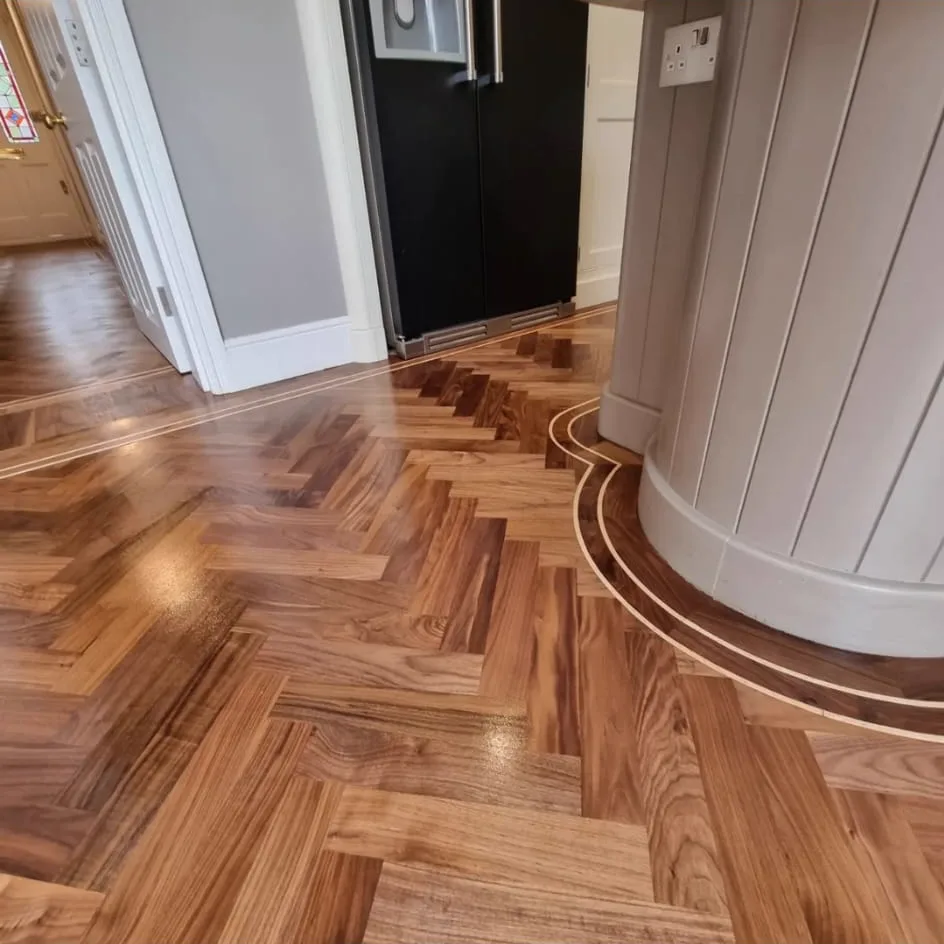
Then the border. A single or double border frames the field, gives the pattern a clean stop before the skirting, and makes the whole floor look intentional rather than tipped in. A contrasting feature strip, walnut against oak is the classic, sharpens it further. The floor in this photo is exactly that: a walnut herringbone in Fulham with a double inlay border, curving around the kitchen island rather than stopping dead at it. Inlays and mosaic panels are slower work still, and we'll price them honestly on the site visit.
More of our pattern work is in the gallery, and what clients say about it is on the reviews page.
Honest Matchmaking
What Suits a Terrace, a Mansion Flat, an Extension
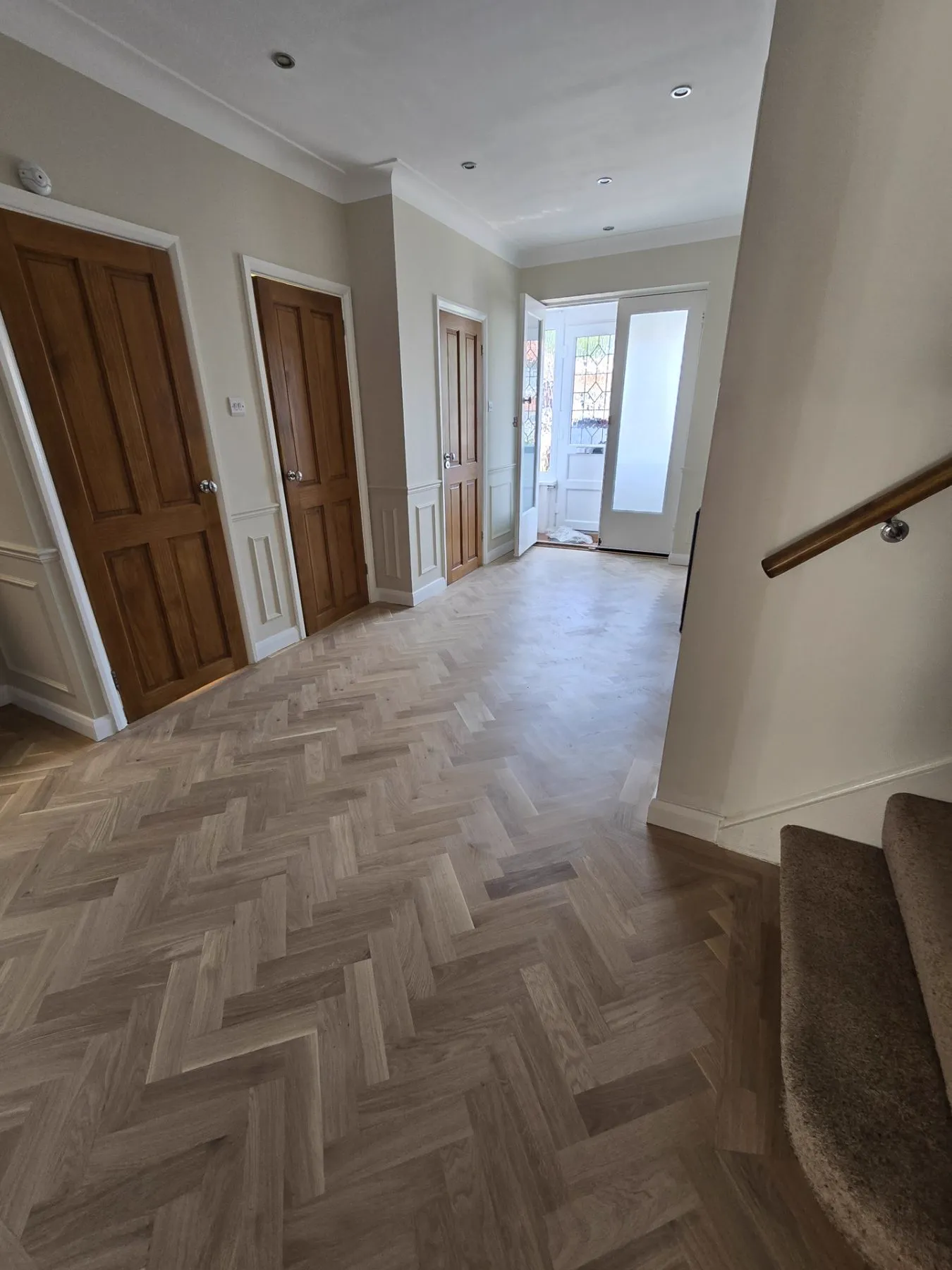
A Victorian terrace takes herringbone like it was built for it, because plenty of them were. Smaller blocks in a warm oak, a border in the reception rooms, and the pattern running front to back makes the classic narrow London plan feel longer and grander than it is.
A mansion flat is where parquet actually comes from: 1930s blocks in herringbone and basket patterns were laid across London by the mile. If you're putting pattern back into one, we keep the block scale honest to the building, and where sound matters between flats the glue-down build-up is chosen with that in mind.
A kitchen extension is the modern home for chevron and large-format herringbone. Big glazed rooms with long sightlines suit the bigger blocks, engineered boards handle underfloor heating properly, and a lacquer finish stands up to the hardest-working room in the house.
Not sure which way to go? That's what the free site visit is for. We'll stand in the room with you and tell you what we'd lay in our own house, and you can preview patterns on your own room first with the floor visualiser: upload a photo and it lays the floor for you, planks or herringbone, in any of the 21 Staki colours.
Before the First Block
Flat, Dry and Sound, Then We Wait
Glue-down pattern work is only as good as what it's glued to. The subfloor has to be flat, dry and sound: high spots ground off, dips filled with levelling compound, loose boards fixed, and where old floorboards are too uneven to glue to, a plywood overlay goes down first to give the adhesive one continuous, stable surface. We check moisture before anything is ordered, because adhesive over a damp subfloor is a floor that fails.
Then the honest part nobody likes hearing: the wood waits. Engineered boards spend 48 hours on site in their sealed packs, settling to your home's temperature and humidity. Solid blocks need longer, up to a week stacked loose in the room they'll live in. Fit a pattern floor the day it arrives and it will move afterwards, and in herringbone, movement shows. We will never promise same-day fitting, and we'd be careful of anyone who does.
All of this is planned at the quote stage, so the timeline you get includes the waiting, the prep and the fitting: a date, not a guess.
Supplied & Fitted, or Fitted Only
We Can Supply the Boards Too
Most clients have us supply and fit: real samples in your hands before any decision, boards from the trade suppliers we've bought from for years, and one firm responsible for the whole floor from subfloor to final coat. Engineered herringbone formats are available through our shop on an enquire-to-order basis, so you're choosing from wood we'd put our own name next to, not guessing from a screen. Already bought your blocks? We'll fit those too, and tell you straight if they're not right for the room.
This page is about new pattern floors going in. Already have parquet? If there's an existing parquet floor in your home that's tired, loose or hiding under carpet, that's restoration work, not fitting: our parquet restoration page covers re-bonding loose blocks, dealing with old bitumen and sanding a pattern floor without dishing the block edges.
And for straight planks, boards and everything else we install, start at the installation page: it's the hub for all our fitting work.
The Two Names on the Van
Pattern Work Is Not a Job for Whoever Turns Up
Herringbone punishes shortcuts. An out-of-square spine, a rushed setting out, blocks tapped in without checking the line: every one of those mistakes repeats itself across the whole floor. That's why one of us, Dean or Luke, is on every job, with over 40 years' combined hands-on experience between us. The person who measures your room and writes the quote is on site when the pattern goes down.
We're on Checkatrade, we carry public liability insurance, certificate on request, and more than 50 Google reviews rate us 4.9. Some of that pattern work is on the site already: the white chevron we supplied and fitted in Camberwell, the herringbone we brought back in Purley, the finger-block mosaic in Chipstead and the chevron work in Dulwich.
No Obligation
Thinking about a pattern floor? One of us will bring samples and set out the options in your own room.
Book a Free Site VisitStraight Answers
Herringbone Fitting Questions, Answered
What is the difference between herringbone and chevron?
Why do you only fit herringbone and chevron glue-down?
What block sizes can I choose?
Can you fit borders and inlays?
Do you supply the blocks or just fit them?
How long does herringbone fitting take?
Does my subfloor need work before the pattern goes down?
How much does a herringbone floor cost?
From Our Google Reviews
"HowardNaish flooring Ltd supplied me with some top quality oak block flooring which they laid in a herringbone pattern. I couldn’t be happier with the end result. I could not recommend them higher - Professional at all times and great chaps."
Thirty Seconds, Five Boxes
Tell Us About Your Pattern Floor
Leave your details and we'll ring you back to arrange your free site visit.
We're booking about three months ahead at the moment, and a deposit holds your place in the queue. Dates tight? Ring us anyway, cancellations happen and smaller jobs can often be slotted in.
Every job is backed by the Howard Naish Workmanship Promise: 2 years on installation, 12 months on sanding and refinishing. If our work fails, we fix it.
Free Quote, No Obligation
The Pattern Starts With a Visit
A free site visit, samples laid out in your own light, and a fixed quote in writing.
020 3131 0122