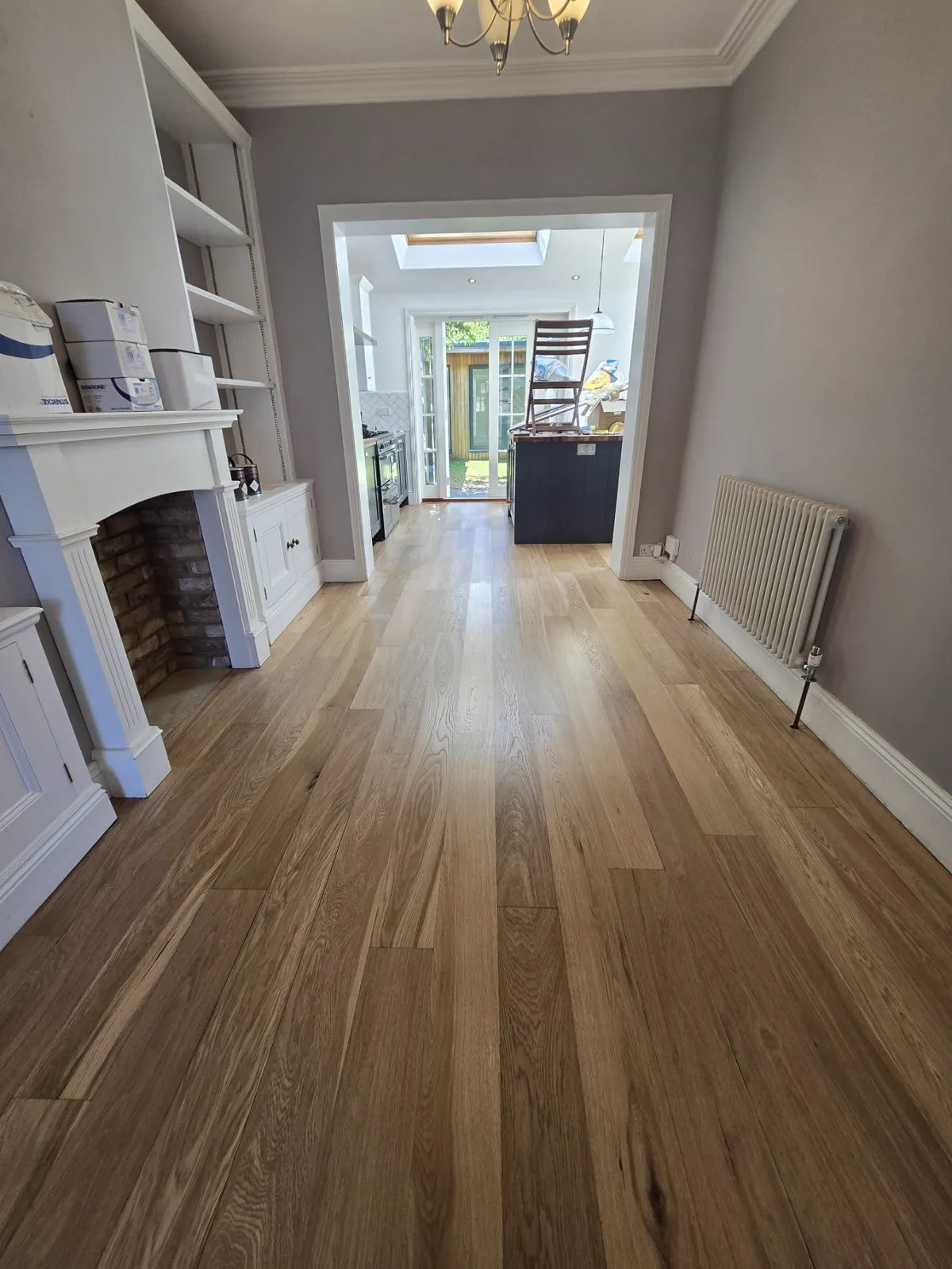
The Job That Built the Business
Floor Sanding in London
A proper three-stage sand with machines we own, finished in oil or lacquer, done by the same two partners who priced it.
★★★★★ 4.9 from 53 Google reviews
Home · Floor Sanding London
The Question Everyone Asks First
Our Sanding Is Near Dust-Free
The number one worry people have about floor sanding is dust: clouds of it settling on curtains, drifting into the kitchen, coating every surface in the house. It used to be like that. It is not any more.
Every sanding machine we use, from the Lagler Hummel belt sander down to the triangle sander in the corners, connects to industrial dust extraction. The dust is captured at source, pulled straight off the floor and into a sealed bag before it reaches the air. It captures around 95 percent of the dust at source, the honest ceiling in this trade, so instead of a film of dust through your home you can expect a light wipe of the windowsill in the room we worked in, and the rest of the house left close to untouched. The honest detail, including the number nobody else will give you, is on our dust-free floor sanding page.
If you have been searching for dust-free floor sanding in London, here is the honest version of that promise: our floor machines capture around 95% of the dust at source, and nobody in this trade is truly 100% dust-free. What is left is a little fine dust near the skirtings, not a cloud through the house. That is the claim we are happy to be held to on wood floor sanding of any kind, and how clean the house stays is one of the first things people mention in our reviews.
We invested in proper extraction equipment years ago because we are in people's homes every day, and nobody wants to live in a building site. It also makes a better floor: airborne dust that settles back into wet lacquer or oil leaves a gritty texture under bare feet. Extracting it at source means the finish goes on clean.
Guide Prices
Hardwood sanding from £30-50/m² · Pine sanding from £40-60/m² · plus VAT
Every job is quoted individually after a free site visit. The price depends on the condition of the floor, the finish you choose, and the amount of preparation needed. For a fully worked example with real numbers, see our floor sanding cost guide. If you are thinking about a new floor rather than sanding, the installation cost guide covers supply and fitting.
What Three-Stage Actually Means
One Sand, Three Distinct Stages
When our quotes say three-stage sanding, it means your floor is machine-sanded at least three separate times, each pass with a finer abrasive than the last. The first cut goes through the old finish and takes the boards back to bare timber. The middle passes flatten the floor and chase out the marks the first cut leaves behind. The final stage is the finishing pass, taken as fine as your chosen finish needs, and finer still if the floor is being stained, because colour shows every shortcut.
- Belt sanding with the Lagler Hummel, not the drum sander you get from a hire shop
- Edges done with a dedicated edge sander, corners by hand with a triangle sander
- A buffer pass to blend field and edges before any finish goes near the floor
- We own every machine we use, nothing is hired for the day
The clip here is one of ours, mid-job: the Hummel making a cut. The full process is written up in our pine sanding guide, and the hardwood version in our oak sanding guide.
The Lagler Hummel mid-cut. This is what a three-stage sand looks like from the handle end.
From First Call to Finished Floor
What to Expect When You Book a Sand
- 1 Free site visit. One of us comes to your home, looks at the floor, measures up and talks through your options. No pressure, no hard sell. We will tell you honestly whether the floor needs a full sand, a light refresh, or something else entirely.
- 2 Written quote. A fixed price in writing, valid for 30 days. No surprises, no extras added on once the machines are in the room. If the floor needs board repairs or gap filling, that is itemised separately so you can see exactly what you are paying for.
- 3 Preparation. We tape up doorways and protect kitchen worktops, fittings and anything else that needs shielding. Rooms cleared before we arrive make for the quickest job, and you know your own pieces best. You don't have to be home either: hand us a key, we lock up properly at the end of each day and hand it back with the finished floor.
- 4 Sanding. The three-stage sanding process with industrial dust extraction on every floor machine. Belt sander across the open floor, edge sander tight to the skirting, triangle sander in every corner and around radiator pipes, then a buffer pass to blend everything into one even surface.
- 5 Finishing. Your choice of lacquer or oil, confirmed with a free patch test on your own boards so you can see the colour and sheen before the final coats go on. Lacquer finishes get three coats; oil finishes get two. If you want a colour change, we apply the stain while the boards are bare, then finish over the top.
- 6 Handover. We clean up, put furniture back, walk you through your new floor and leave you with a free aftercare kit: the right cleaner for your finish and a care guide so you know exactly how to look after it going forward. Anything else you need later is in our shop.
No Obligation
One of us comes out, looks at the floor, and puts a fixed price in writing.
Book a Free Site VisitTimings
How Long Does Floor Sanding Take?
A typical room (around 15-20m²) takes two to three days from bare boards to a finished, walkable floor. A whole house might be five to seven working days depending on the size, the condition of the timber and the finish you choose. Oil cures faster between coats than lacquer, so an oiled floor can sometimes be done in a day less.
We will give you an honest time estimate on the site visit, and if the job runs into complications (hidden damage under old carpet, or boards that need more preparation than expected) we tell you before the cost changes, not after.
Our Kit
Professional Equipment, All Owned
We own every machine we use. The Lagler Hummel belt sander does the heavy cutting across the open floor. The Lagler Flip edge sander runs tight to the skirting. An orbital sander and a four-pad handle the finishing passes and blending. A triangle sander gets into corners, around radiator pipes and along stair nosings where nothing else fits.
Owning the kit matters because we know every machine inside out, we maintain them ourselves, and we are never waiting for a hire shop to deliver. It also means every floor machine has proper industrial dust extraction fitted, not a domestic vacuum adapter bolted on as an afterthought.
Before and After
From Near-Black Back to Natural Oak
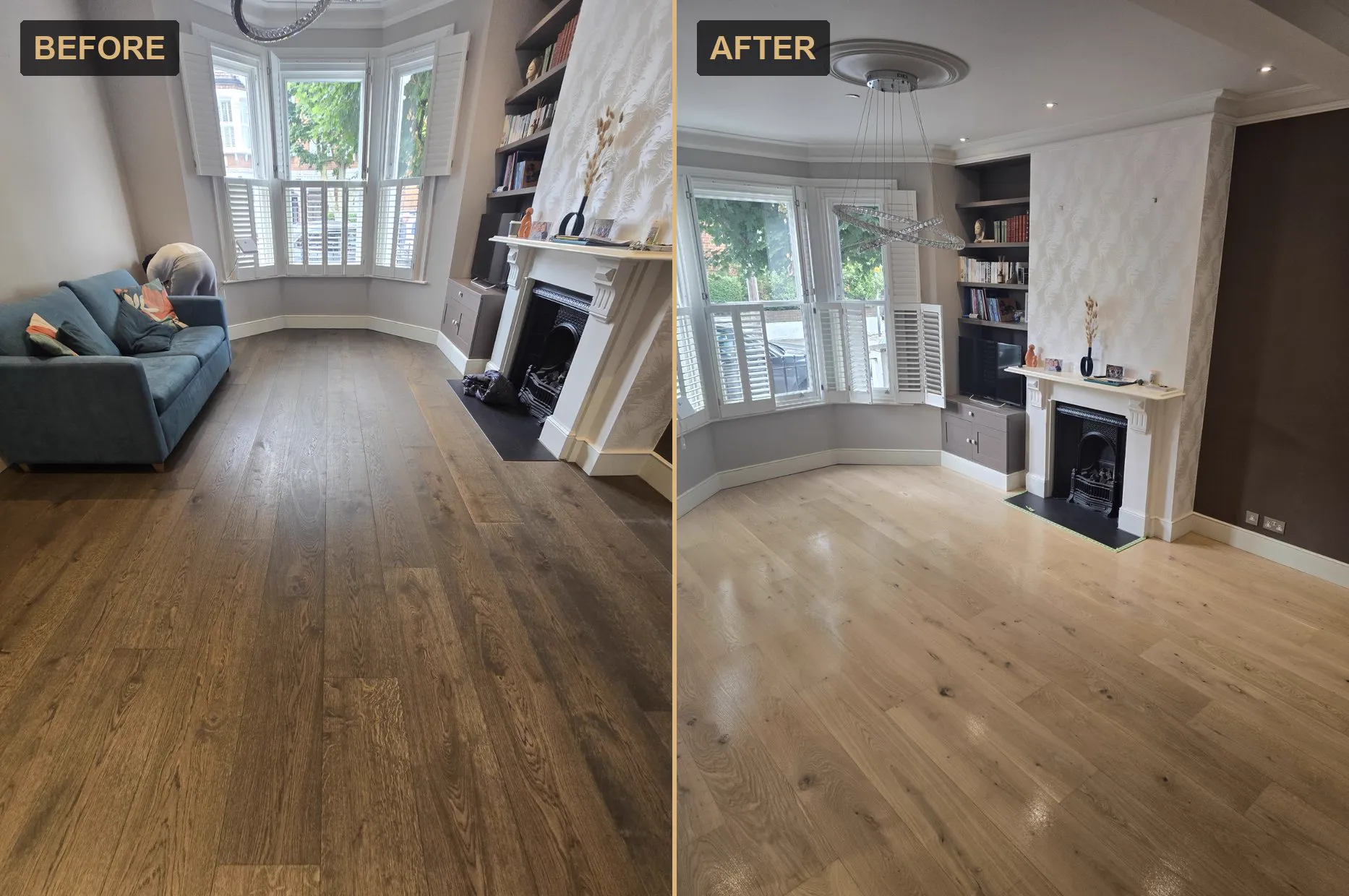
This oak came to us stained near-black, and the brief was the opposite of most: take it back to how the tree intended. Sanding out a dark stain is slower and less forgiving than sanding a clear finish, because the colour sits down in the grain and shows any unevenness. It's routine work for us. If you've inherited a colour you hate, it isn't permanent.
The Order of Work
Repairs, Gaps, Sand, Finish. In That Order.
A floor that has been walked on for decades rarely just needs sanding. There is almost always preparation first, and the order matters. When the preparation is the bigger half of the job, boards to replace, a floor to rebuild before it can shine, that is restoration territory: our wood floor restoration page covers the whole rescue, and original pine boards get their own page on floorboard sanding and restoration.
Damaged boards are repaired or replaced before the machines come out. Where the floor is original pine or reclaimed hardwood, we source matching reclaimed timber so the repair ages with the rest of the room rather than standing out as a bright new patch: here is how we do board repairs. Loose boards are screwed down. Protruding nails are punched below the surface so they do not tear the abrasive belt on the first pass.
Gaps are filled with flexible filler rather than hard resin, so the filler moves with a suspended timber floor through the seasons instead of cracking out and leaving the gap worse than before. The widest gaps get traditional timber slivers, fitted the way it was done a century ago. You feel the difference in draughts as much as you see it in the floor. We have written up why flexible filler wins.
Then the three-stage sand, then the finish: two coats if you choose an oil, three coats if you choose a lacquer. Not sure which suits your home? We have written an honest comparison of the two. And if you fancy a colour change while the boards are bare, that is the moment. Our staining page shows the twelve LOBA colours and how the free patch test works. You can even upload a photo of your room to the visualiser and preview the colour before we start. Still weighing up firms? Our guide to choosing a floor sanding company in London sets out the questions worth asking anyone, including us. And if you are south of the river, start with our South London home patch: eighteen areas, each with its own job story.
Wondering about money? The real numbers, what moves them and a fully worked example are in our floor sanding cost guide.
Free Site Visit
We quote from the floor itself, not from photos. The visit is free and the price is fixed in writing.
Book a Free Site VisitNot Just Sanding
Wood Floor Installation Across South London
Floor sanding is half of what we do. The other half is fitting new wood floors: engineered oak planks, solid hardwood, herringbone, chevron and parquet. We supply the boards and fit them, or fit boards you have already sourced.
Herringbone and chevron are always glue-down, no exceptions. Wide-plank engineered oak can be floated on underlay or glued depending on the subfloor. We will advise on the right method during the site visit, because the wrong one leads to movement, noise and callback jobs that nobody wants.
If you are replacing an existing floor, we handle the full scope: lifting the old boards, preparing the subfloor, fitting the new timber and sanding it in if the boards arrive unfinished. One team, one quote, one point of contact from start to finish. Details and pricing are on our installation page, and the installation cost guide breaks down the numbers.
We also restore existing parquet. Parquet floors are common across London, from Victorian terraces to 1930s mansion flats, and they need a different touch. Blocks come loose, the bitumen adhesive underneath can fail, and a careless sander will dish the edges of individual blocks. Our parquet restoration page explains the process in detail.
Straight Talk
We Will Tell You If It Does Not Need Sanding
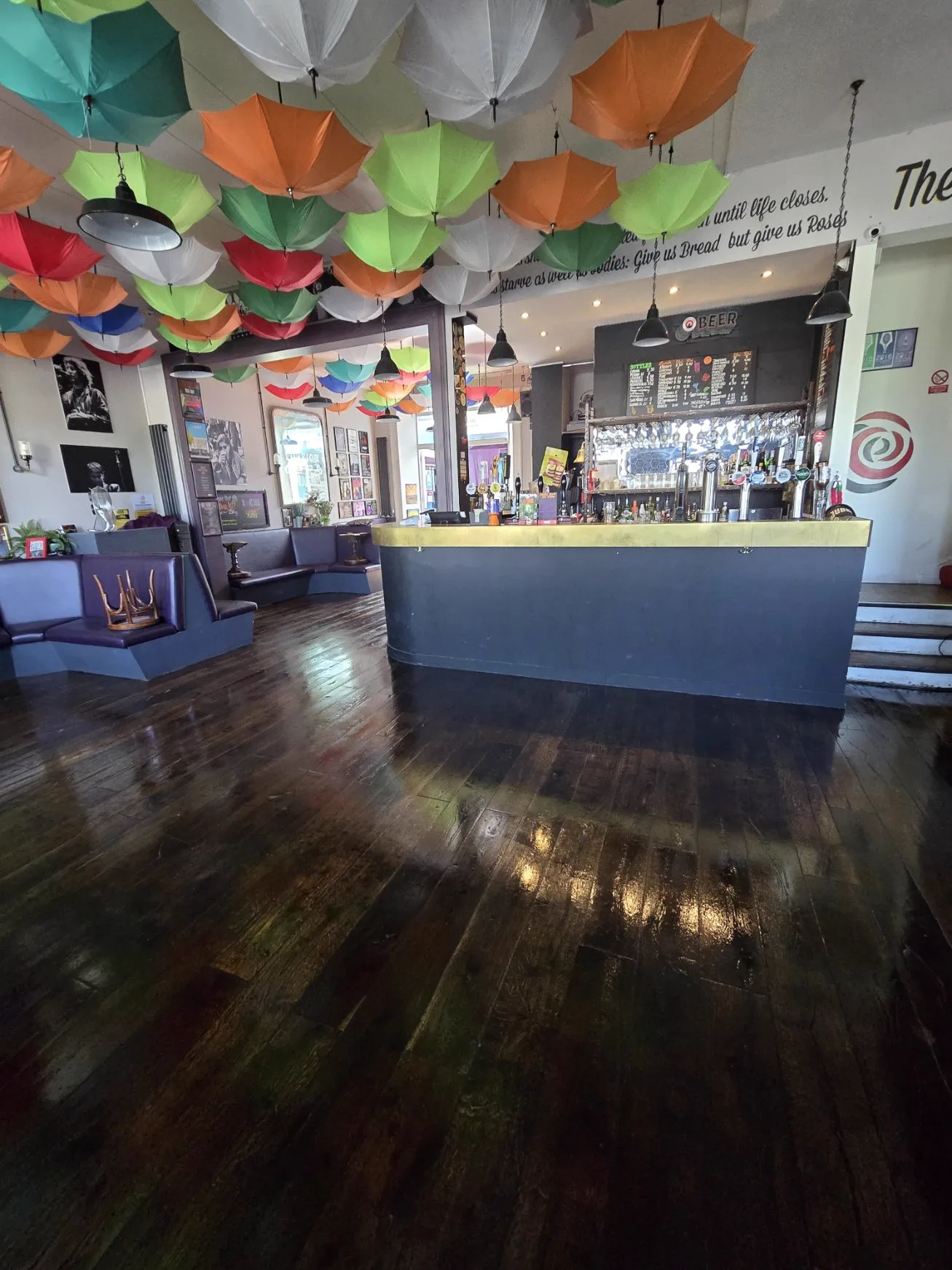
Every floor only has so many sands in it, so we do not spend one lightly. Some tired floors, especially oiled ones, just need a deep clean and a fresh feed. The pub floor in this photo, The Bread and Roses in Clapham, was revived without a single pass of a sanding machine, and the bill was a fraction of a full sand.
If that is the truth about your floor, that is the advice you will get on the site visit. We would rather tell you it does not need sanding and lose the job than sand a floor that did not need it. The full story is in not every floor needs a full sand. And if the finish is sound but tired, what most people mean when they search for floor sanding and polishing, a machine buff and one fresh coat may be all it takes: that is exactly what our Floor Care Plan does once a year.
We sand and install floors across South London and central London. If you are local to one of our regular patches, see the area pages for Balham (our home patch), Clapham, Dulwich, Wimbledon, Purley, Kensington, Gipsy Hill, Brixton, Tooting, Crystal Palace, Streatham Hill, Putney, Fulham, Battersea and Chipstead. Schools, pubs and offices are on the commercial page.
Family Run Since Day One
The Two Names on the Van
Howard Naish is Dean Naish and Luke Howard. The company name is both our surnames. Between us we have over 40 years of hands-on flooring experience, and one of us is on every single job. The person who comes to your home to look at the floor and write the quote is the same person who turns up with the machines and does the work. That is the promise, and it is why more than 50 reviews on Google give us a 4.9-star rating.
We are not a franchise. We do not subcontract the work out to people you have never met. When you ring us, you speak to one of us. When we are on site, you can ask questions about your floor and get an honest answer from someone who has been doing this since they were seventeen.
We are based in Balham. South London is the bulk of it, and we are over in Kensington and Chelsea regularly too. Domestic work is the core of the business, from single rooms in Victorian terraces to whole-house sands in five-bedroom family homes. The first floor we ever sanded under our own name was a small pine bedroom a few streets from here, and that job is set out in full in our Balham floor project. We also take on commercial jobs across the capital: schools, pubs, offices, church halls. The process is the same; the scale is different. Read more about us here.
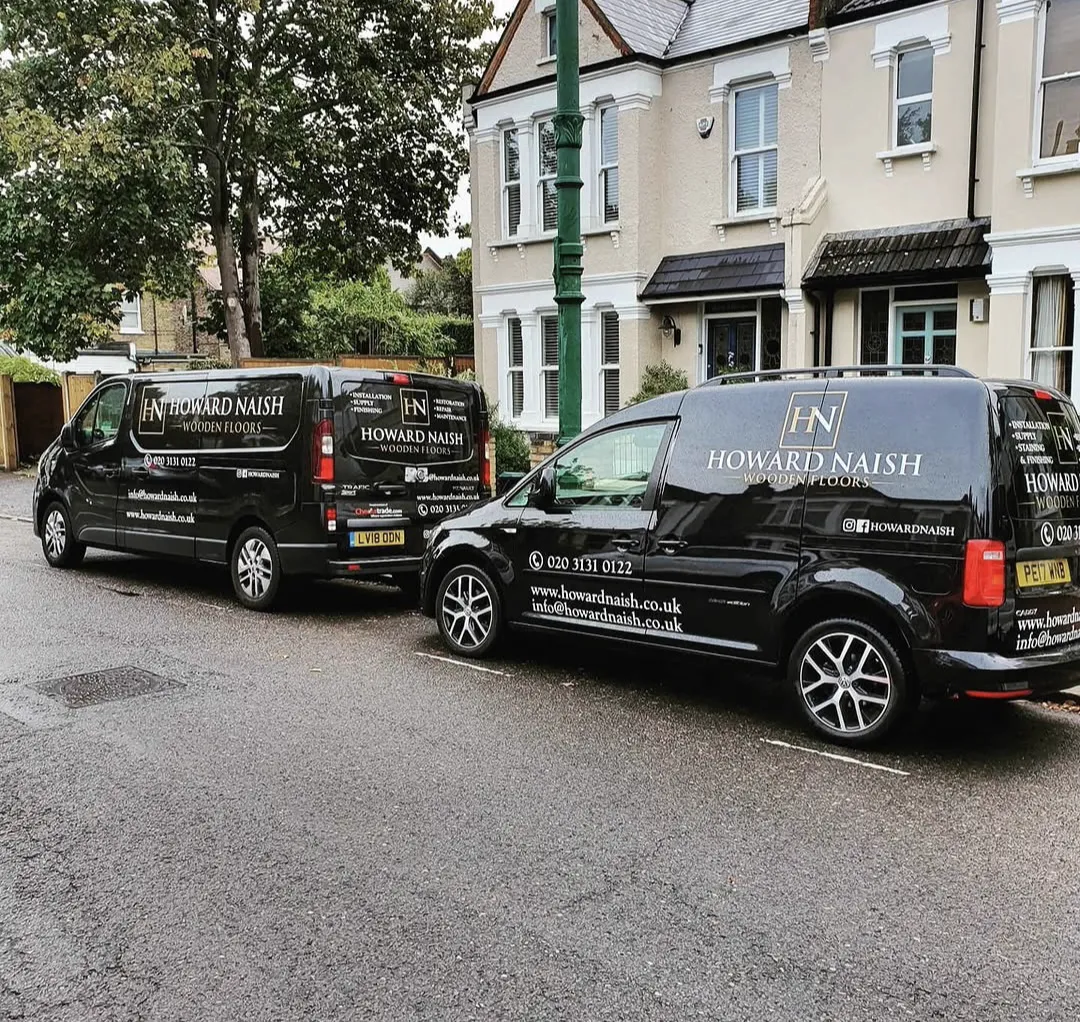
Both vans outside a job. If they're parked on your street, one of us is inside on the machines.
Straight Answers
If the floor doesn't need the full works, we'll say so. The visit costs nothing either way.
Book a Free Site VisitStraight Answers
Floor Sanding Questions, Answered
What does three-stage sanding mean on my quote?
Will you get into the corners and right up to the skirting?
My floor was stained dark years ago. Can it go back to natural?
Do you fill the gaps as part of the sand?
How many coats of finish do you apply?
Who actually turns up to do the work?
Is floor sanding dusty?
How long does a typical floor sanding job take?
Can I stay in the house while you sand?
Do you install new wood floors as well as sanding?
What areas of London do you cover?
From Our Google Reviews
"We had our kitchen/dining room floor restored. The quotes were good; clear, straight forward - no hidden extras. They were flexible & accommodating, they gave good sound honest advice with no nonsense! The work itself was to a very high standard. The guys that did the work were really nice, professional & friendly. They were so good we had them back to restore the lounge floor a month later. Would recommend Howard Naish to anyone."
Thirty Seconds, Five Boxes
Tell Us About Your Floor
Leave your details and we'll ring you back to arrange your free site visit.
We're booking about three months ahead at the moment, and a deposit holds your place in the queue. Dates tight? Ring us anyway, cancellations happen and smaller jobs can often be slotted in.
Every job is backed by the Howard Naish Workmanship Promise: 2 years on installation, 12 months on sanding and refinishing. If our work fails, we fix it.
Free Quote, No Obligation
One Free Visit Settles It
We look, we tell you straight, and the fixed quote lands with you in writing.
020 3131 0122