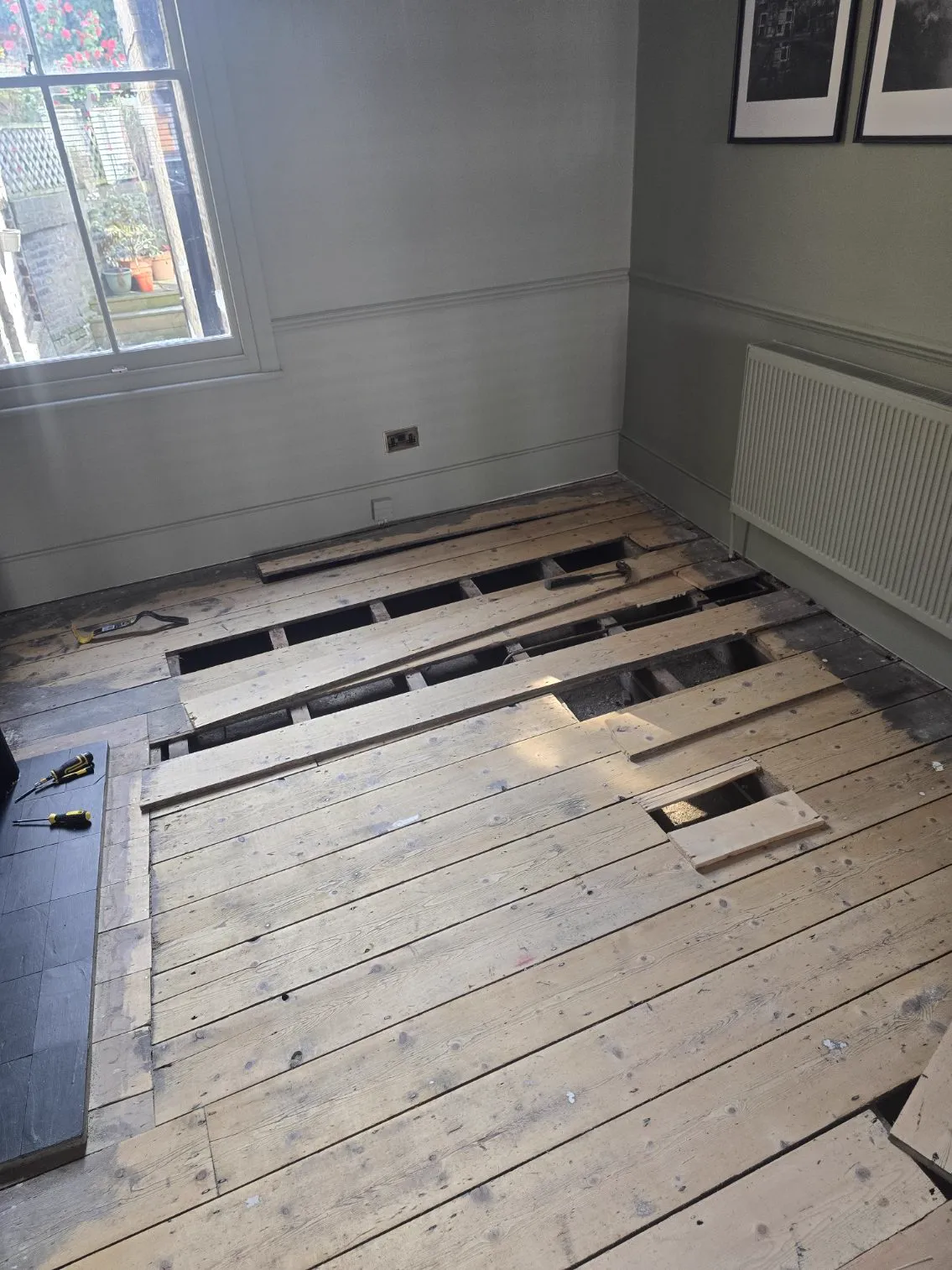
The photo above is a floor of ours mid-repair: damaged pine boards just lifted, joists showing, replacements about to go down. If your original pine floor needs work, sooner or later you'll see something like this in your own front room, and it looks more alarming than it is. So let's talk about repairs, and about the one decision that makes or breaks how they turn out.
Most Old Pine Floors Need Some Repairs
After a hundred years or more of life, it comes with the territory. Sometimes it's minor: a split board here, a patch of woodworm there, a section chewed up around an old pipe run. Sometimes it's bigger, and whole runs of boards need to come up and be replaced. Plumbers and electricians of decades past were not gentle with floorboards, and neither were the years of carpet grippers, nails and moving furniture.
None of this is a reason to give up on the floor. It's a reason to repair it properly. Repairs like these are part and parcel of the original pine floorboard work we do week in, week out.
The Decision That Matters: Reclaimed, Not New
Here's the bit most people don't know. When we replace boards in an old pine floor, we don't use new pine. We buy reclaimed boards, timber of the same age and character as the floor we're repairing, and here's why.
They genuinely don't make pine like they used to. The pine in a Victorian floor came from slow-grown trees, decades older and denser than anything harvested today, with tight growth rings and a deep, waxy character that only gets better with age. Modern pine is fast-grown plantation timber: wide rings, soft, and far, far lighter in colour. Drop a new board into a hundred-year-old floor and it shouts at you from across the room, and it will still be shouting years later, because it will never catch up with the old boards around it.
A reclaimed board is the same age as its neighbours. Same density, same tone, same story. Once it's fitted, sanded and finished with the rest of the floor, you'll struggle to point at the repair. That's the whole aim: a repair you can't find.
Where the Boards Come From, and How We Match Them
Our reclaimed pine comes from Dulwich Reclamation Ground, a salvage yard we've worked closely with for years. They're brilliant, and they hold hundreds of old boards at any one time, lifted from period buildings all over London. Having a yard like that on the doorstep is half the reason our repairs disappear.
The matching is a little ritual we've refined over the years. We take a board up from the floor we're actually working on, already sanded back, and carry it to the yard. Then we hold it against their stock, board by board. The trick is to read the END of each board, not the top: the top face of a salvaged board is a century of dirt and old finish, but the sawn end shows you the timber's true colour and the tightness of its rings. That end-grain comparison tells us whether the board will blend or shout.
And when it's too close to call? They let us sand a patch of the candidate board right there in the yard. Bare timber against bare timber, no guessing. It takes longer than ordering new boards from a merchant, and it's the reason you can stand in the finished room and not find the repair.
How a Repair Actually Goes
- We assess board by board. Plenty of boards that look rough are sound underneath and only need sanding. We only lift what's genuinely beyond saving.
- Damaged boards come up carefully, without wrecking their neighbours, and we check the joists beneath while we're there.
- Reclaimed boards go in, cut to fit and fixed properly to the joists.
- Then the whole floor is sanded together, old boards and reclaimed repairs in the same passes, and finished as one floor. That's what blends it all into a single surface: the repair isn't finished to match the floor, it IS the floor.
Gaps get dealt with in the same visit: read why we fill pine floors with flexible filler, not resin.
So Don't Panic When Boards Come Up
If we tell you some boards need replacing, it's not the beginning of the end for your floor, and it doesn't mean a patchwork of pale new timber. It means the damaged bits leave, timber of the same vintage takes their place, and the whole thing gets sanded and finished as one. The old stuff is worth saving. You simply can't beat it.
Repair Questions, Answered Straight
Why use reclaimed boards instead of new pine?
How do you colour-match a reclaimed board to my floor?
Will I be able to see the repair afterwards?
Worried about the state of your pine boards? Let us look before you write them off. You'd be amazed what's under there.
Call us: 020 3131 0122
Email: [email protected]
Or book a free site visit. The full restoration story is here: how we sand a pine floor, step by step.