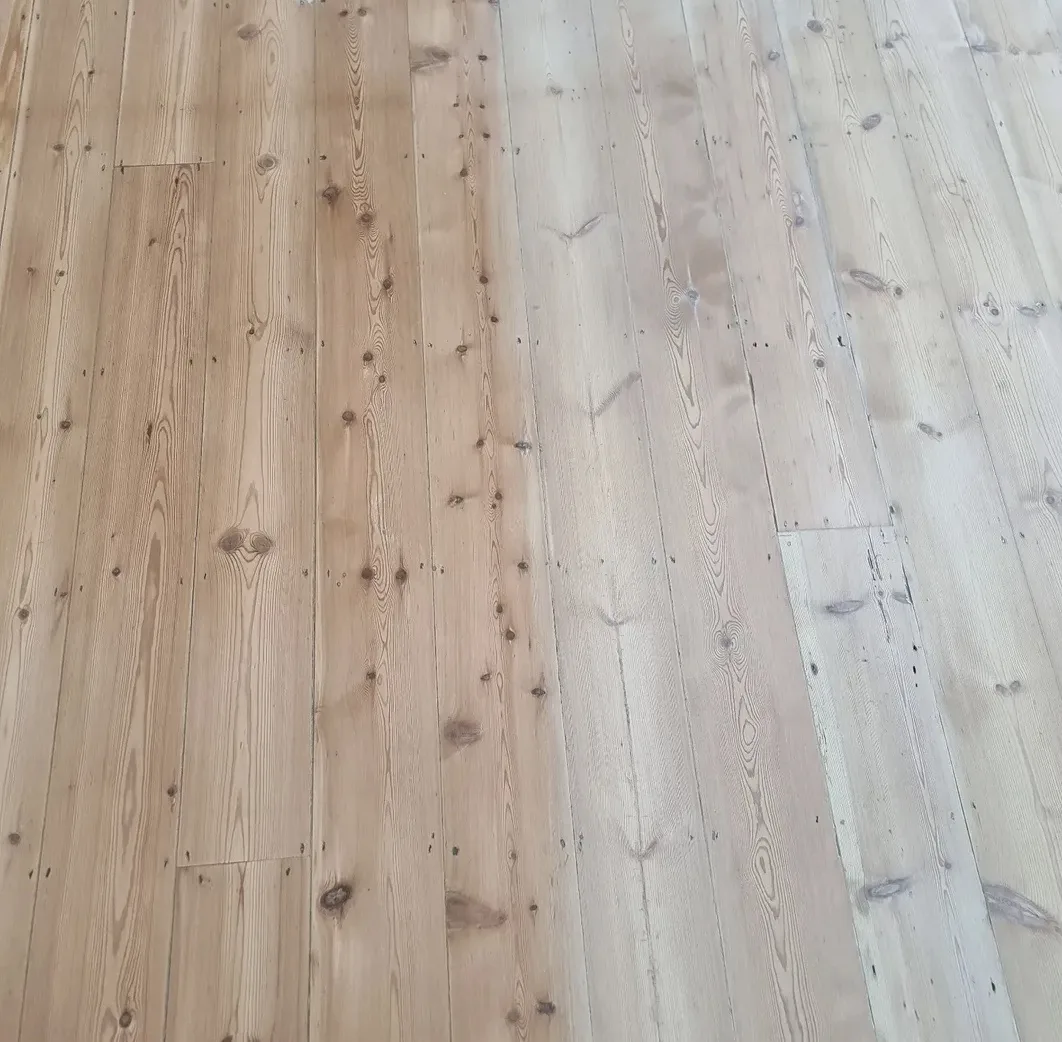
That photo is one floor, taken halfway through a finish coat. On one side, the orange pine everyone recognises. On the other, the same boards, light and fresh. No stain involved. Just a white pigment working in the lacquer, taking the orange out of the pine as it goes.
Most people with an old pine floor think orange is all it can be. This post is about why that isn't true any more.
Why Does Old Pine Always Look Orange?
When we first arrived at a recent job on Hydethorpe Road in Balham, the floor was really old, previously sanded pine. A lot of the old finishes used to turn very, very orange over time. And they were naturally orange when they were first put down, because anything you put onto bare wood back in the day, especially pine, used to naturally bring out those orangey tones. Even if you just put water onto bare pine, you can watch it want to go orange.
This floor had an old finish that was really orange and really worn in places. The brief was simple: eliminate the orange completely and keep the floor as light and as fresh as possible. The client didn't think it was possible to achieve anything but orange on pine. Most people with old pine floors don't.
You Don't Need to Stain It
People used to stain pine to try to avoid that orange colour. You don't need to any more. We now have the products to keep pine light, fresh and neutral using nothing but the finish itself.
Light and neutral is worth having. It goes with all your decor, and if you repaint or change your furniture in years to come, the floor still matches everything. Once you start going into stronger colours, it limits what you can paint the walls and what furniture works in the room.
The White Ladder: One, Two or Three
The way we do it is with a white pigment added to a professional water-based lacquer. Every floor gets three coats; you choose how many of them carry the white:
- One coat of white achieves an almost invisible finish, followed by two normal coats.
- Two coats of white lightens the pine ever so slightly, with one normal coat on top.
- Three coats of white starts to really put white pigment into the floor.
Tested on Your Floor, Not a Brochure
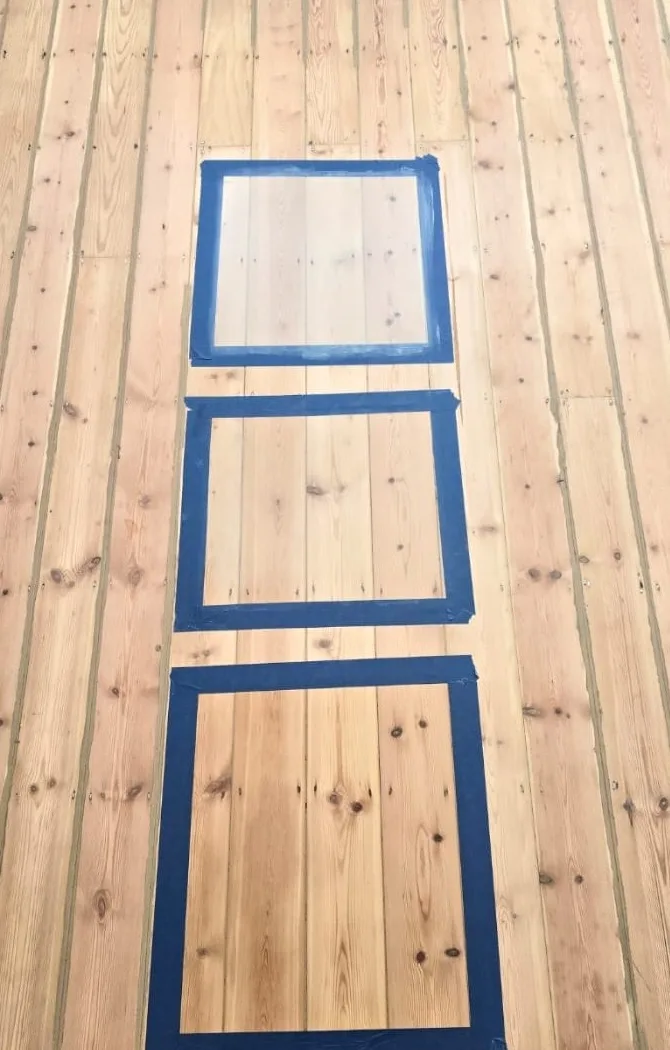
We tape out squares and apply the real options on your actual boards, in your light, and you choose from there. The same finish behaves differently on every floor, so a swatch card in a showroom tells you very little. Your own boards tell you everything.
You might notice the filler lines between the boards in that photo, an oaky colour sitting in the gaps. That's the flexible filler, and it's there because we patch test before the final sand. The test squares and the excess filler get sanded off together, so the whole floor is finished evenly in one go rather than re-sanding random patches at the end.
The Filler, and Why Medium Oak Matches Pine
The filler in that picture is actually called medium oak. Believe it or not, medium oak is sometimes the perfect match for pine. And because the white slightly tints the floor, it tints the filler too, so the boards and the filled gaps come out one even, matched colour.
Some people prefer a brown filler instead, and it's a fair choice: it keeps the authentic, classic look where you can still see the lines of the boards, as if the gaps were never filled.
The Other Two Natural Looks
The white wash isn't the only no-stain option. There's an invisible finish: if you're not quite brave enough for the wash but you don't want the old orangey look, that's your safe bet in between. It's very close to invisible, though not purely, it puts the slightest tint in. That's why using the white you can sometimes achieve a better invisible look than the invisible itself.
And there's a classic warm tone, which we'd point you towards in an old cottage or on a church floor, anywhere the heritage of the building matters and the floor should stay original-looking with the rest of the house.
The Result
At Hydethorpe Road we stripped the old floor completely back to bare wood, the same full sand we give every pine floorboard job, filled the gaps with flexible filler, and finished with three coats of the white.
The client was shocked it was even achievable. She honestly didn't believe her floor could ever look like that.
Pine Finish Questions, Answered Straight
Why do old pine floors go orange?
Do I need to stain pine to stop it looking orange?
What is the filler I can see between the boards in the photos?
Got a pine floor you assumed was stuck orange? The patch test is free, on your own boards, and you'll see all three strengths of the white before deciding anything.
Call us: 020 3131 0122
Email: [email protected]
Or book a free site visit. You can also try lighter floors on a photo of your own room with the floor visualiser, and read more about choosing between finishes on our oil or lacquer guide. The site visit is free, the patch tests are free, and the quote is fixed in writing.