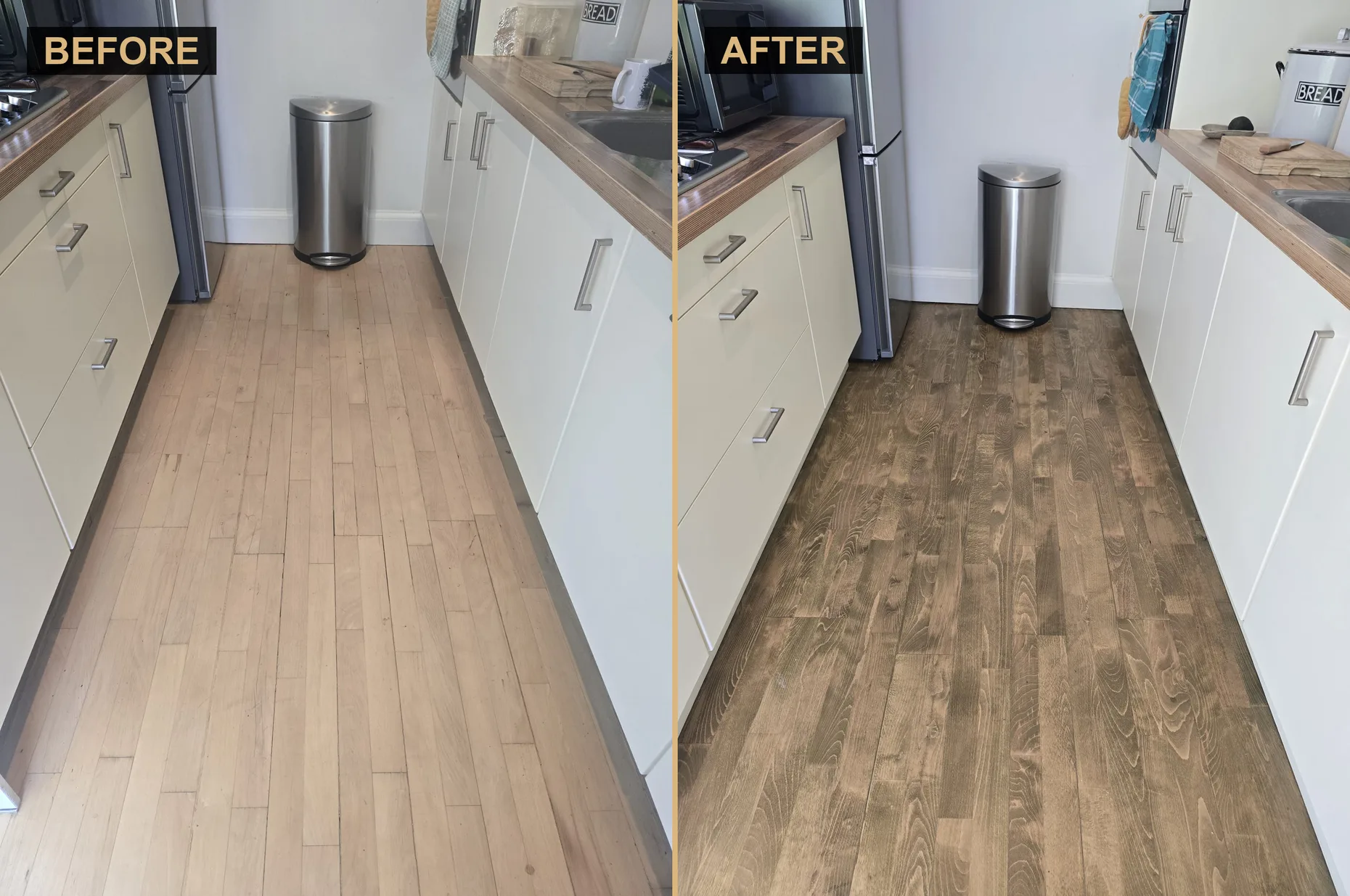
Everyone thinks staining a floor is about the staining. It isn't. By the time the stain goes down, the result is already decided. The colour just develops what the sanding wrote, like an old photograph. Get the preparation right and almost any stain will behave. Get it wrong and no stain on earth will save you.
We stain floors across South London every week, and this is how we get them even, along with the ways we've seen it go wrong.
The Sanding Underneath Is Nine Tenths of the Job
There are no shortcuts through the grits. None. If you're sanding oak, you do not jump from 60 grit to 120, that's too far. You go 60, 80, 120, and on staining work we then go over the whole floor again with a 150 wire mesh.
Each pass has one job: to erase the scratches left by the pass before it. Not to skim over the floor, to actually remove the previous marks. Skip a grit and the coarse scratches stay hidden in the wood, invisible on bare boards, and the stain finds every single one and paints them dark.
Then there's the blending, which is the part you can't learn from a leaflet. A floor is sanded by more than one machine: the big sander down the middle, the edger around the walls, and every machine spins at a different speed and works the wood differently. You have to look, really look, at where the edger meets the big machine and blend those zones together by eye. And every machine must finish on the same grit AND the same abrasive material, right into the corners. Ceramic on one, ceramic on all. Finish the middle on mesh, finish the edges on mesh. Even a slight mismatch and the stain takes differently around the border of the room. In the trade it's called a picture frame, and once it's stained in, the only fix is sanding the whole floor again.
Water Popping: the Step Most People Have Never Heard Of
Here's the catch with sanding to 150: the floor ends up too smooth to stain. The grain is closed and polished, and stain sits on top instead of getting in.
So we water pop: a light, even coat of water over the whole floor that raises the grain and opens the wood back up so it drinks the stain evenly. And "even" is the word that matters, splash it about carelessly and you've just created the blotches you were trying to prevent.
Then the floor must dry fully, and this is where pine catches people out. Pine will look bone dry on the surface while moisture is still working its way out of the boards. Stain over it too soon and the escaping moisture disturbs the colour. Water popping isn't a step you rush; the drying time is part of the job.
Different Stains, Different Speeds
Stains are not one product. Oil-based, spirit-based, alcohol-based, they all apply differently, and some give you far less time than others.
Mylands Light Fast, for example, has to go down fast. Hesitate, let a brushed edge sit too long before the roller meets it, and you'll see the join as a dark band, that picture frame again, this time in the stain itself.
LOBA stains are more forgiving, as long as the sanding beneath them is perfect. We work those in twos: one of us applying with a lamb's wool applicator, brush and bucket in hand for the edges, the other following behind with a cloth, wiping away any excess before it can sit and darken.
Oil stains like Bona Craft Oil and Osmo are the most forgiving on timing, and we apply those with the buffing machine: pour the stain into the centre hole of the buffing pad and work it in. With oils it's not about drenching the floor, it's about driving the oil into the wood.
Some Timbers Behave, Some Fight You
Oak and pine are the easy ones, they take stain readily (pine needs that water popping discipline, but treated properly it stains beautifully). Beech and maple are the ones most firms refuse to stain: tight, unpredictable grain that blotches in unpractised hands.
Exotic woods are a different problem again. Woods like teak and iroko have natural oils in them that try to repel the stain. Sometimes they just need more working. Sometimes the floor needs going over with methylated spirits or white spirit first to stop those oils coming through, and then the stain goes on soon after, before the oils find their way back to the surface. Some exotics we'll tell you straight not to stain at all: the natural colour is the reason you bought that wood in the first place. Either way, an exotic floor always gets a patch test before we commit to anything.
Whatever the timber, every staining job we do starts with free patch tests on your own boards, because the same tin behaves differently on every floor.
The Beech Floor in Gipsy Hill
The before-and-after at the top of this page is a beech floor, kitchen and living room, that we sanded and stained with LOBA Golden Oak. Beech, the timber most firms won't stain, taken to a rich, even, repeatable brown, because every step above was done in order and nothing was skipped. There are more photos of it on our Gipsy Hill page. That floor is the method in one picture.
What Half-Price Staining Looks Like
A while back we quoted a pine floor, and while we were waiting to start, another firm on site told the client they'd do it for half our price. The client said yes. You would.
We were back within weeks to re-sand the entire floor. There were sanding marks everywhere from coarse grits that were never sanded out. Dark rings where the edging machine had scoured the borders. The floor hadn't been levelled, so every dip drank extra stain and sat as a dark patch. The stain was never given time to dry, so when the water-based lacquer went over the top it lifted the colour and left bare-looking patches across the room. Every fault in this article, on one floor.
The only fix was the one we'd have done first: sand it back to bare wood and start again, properly. The client told us they wished they'd used us from the start, and paid for the job twice to learn it. Cheap is not always the best option, and our sanding cost guide explains the questions that expose a thin quote before it's on your floor.
Staining Questions, Answered Straight
Why does floor stain go blotchy?
What is water popping?
Can exotic woods like teak or iroko be stained?
Thinking about a colour change? Try colours on a photo of your own room before you commit to anything.
Call us: 020 3131 0122
Email: [email protected]
Or book a free site visit. You can try colours on your own room with the floor visualiser, and see the twelve colours we offer on our floor staining page. The site visit is free, the patch tests are free, and the quote is fixed in writing.