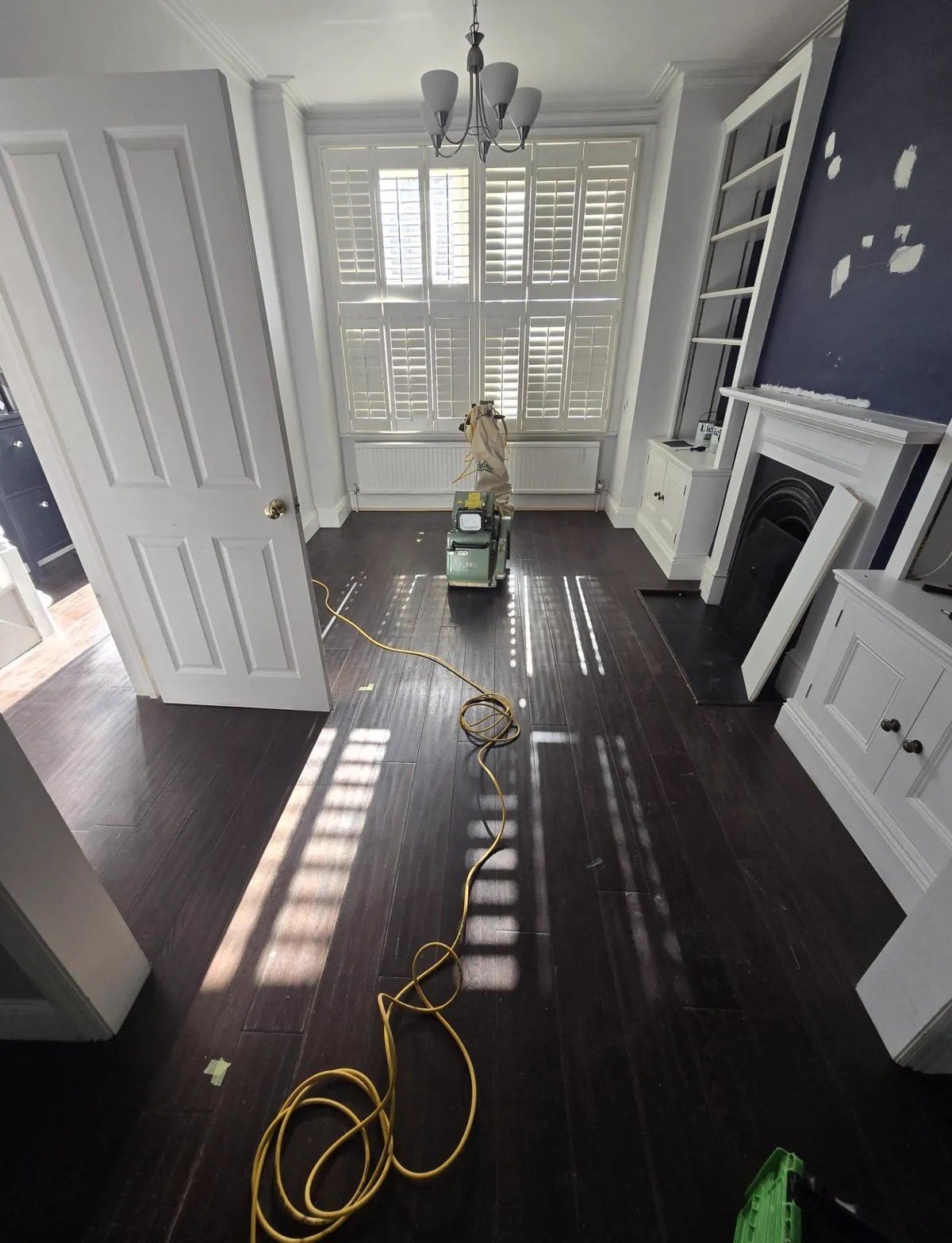
Oak is the king of hardwood floors. Whether it's solid oak boards in a Victorian terrace in Clapham, engineered oak parquet in a Wandsworth townhouse, or a herringbone floor in a Battersea flat, oak has a warmth and richness that no other material can match.
But over time, even the best oak floor loses its lustre. Traffic wears down the finish, scratches build up, and the wood starts to look tired. The good news? Oak is one of the most rewarding floors to restore. The grain is beautiful, the wood is hard-wearing, and with the right process, we can make a 50-year-old oak floor look like it was laid yesterday.
I've been sanding hardwood floors across South London for over 22 years, from period homes in Dulwich and Brixton to modern apartments in Nine Elms and Vauxhall. In this guide, I'll walk you through exactly how we sand an oak floor, step by step, so you know what to expect when we arrive.
Why Oak Is Different to Pine
If you've read our pine floor sanding guide, you'll notice the hardwood process is different in a few important ways.
Oak is a hardwood. It's much denser than pine, which is a softwood. That means we don't need to start with as coarse a grit (we begin at 60 rather than 36), and we introduce an additional machine called a four-pad machine for the final smoothing a belt sander can't manage on hardwood.
The density of oak also means it responds differently to staining. We use a technique called water popping before applying stain, which opens up the tight grain and allows the colour to penetrate evenly. Without it, oak can resist the stain and the finish comes out blotchy.
Our Equipment
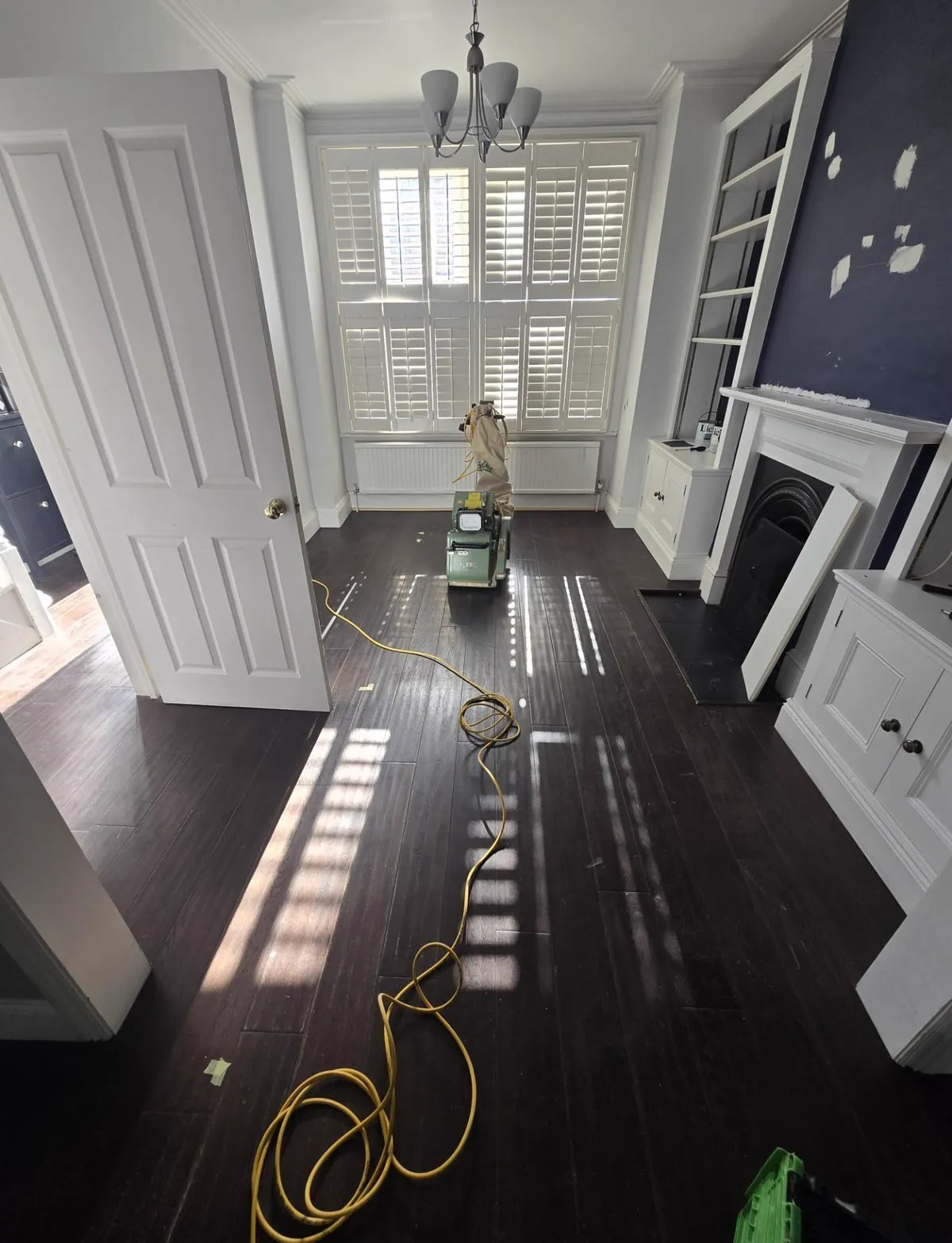
We own all our own professional machinery. No hired equipment, no compromises. For hardwood floor sanding across Balham, Tooting, Streatham, and the rest of South London, we bring:
- Lagler Hummel: 8-inch belt sander, the main workhorse for sanding the floor
- Lagler Flip: edge sander for the perimeter, skirting boards, and alcoves
- Four-pad machine: four rotating discs that eliminate belt sander lines on hardwood
- Orbital hand sander: blends the edges into the belt-sanded middles so the join disappears
- Hand scraper and triangle sander: for perfect corner detail
The Hardwood Sanding Process: Step by Step
Step 1: First Belt Cut (60 Grit)
We start with 60 grit on the Lagler Hummel belt sander. Notice we don't start at 36 grit like we do on pine. Oak is dense enough that 60 does the job without creating unnecessarily deep scratches. The Hummel runs up and down the room in straight, overlapping passes, stripping back the old finish and levelling the surface.
Whether it's a large open-plan living space in a Putney conversion or a compact hallway in a Brixton Victorian, the Hummel handles it all.
Step 2: Second Belt Cut (80 Grit)
We follow immediately with 80 grit on the Hummel. This smooths out the scratch marks left by the 60 grit and starts to show the oak grain properly.
Step 3: Edge Sanding (60 then 80 Grit)
The Lagler Flip edge sander goes around the full perimeter of the room, everywhere the belt sander can't reach. We do two passes: first at 60 grit, then at 80 grit, matching the sequence we used on the belt sander.
In older properties across Camberwell, Herne Hill, and Forest Hill, you often find fireplaces, bay windows, and alcoves with tight edges. The Flip gets into all of these, right up to the skirting boards.
At this stage we're using the edger only, no orbital yet.
Step 4: Four-Pad Machine (80 then 120/150 Grit)
This is the step that separates a hardwood sand from a pine sand, and a professional job from a DIY attempt.
The four-pad machine has four rotating pads on the bottom that move in different directions simultaneously. This completely eliminates any lines or marks left by the belt sander. Something a belt sander alone can never achieve on hardwood.
We start at 80 grit on the four-pad, then move to 120 grit for a natural or clear lacquered finish, or 150 grit if we're staining the floor. The finer 150 grit opens the grain more evenly, which means the stain absorbs consistently and you get a rich, uniform colour across the whole floor.
If you run your hand across a floor we've finished with the four-pad, it feels like glass.
Step 5: Orbital Hand Sander (80-120 or 150 Grit)
Now, and only now, after the four-pad has done its work, we bring out the orbital hand sander. We use it around the full perimeter of the room to remove any circular marks left by the edge sander and blend the edges into the four-pad-finished middles.
For a natural or clear finish, we use 80-120 grit on the orbital. For staining, we use 150 grit to match the four-pad finish and ensure even stain absorption right to the edges.
We never use the orbital before the four-pad cut. It would be wasted effort as the four-pad pass would need the edges redone anyway.
Step 6: Hand Scraping and Triangle Sanding the Corners
This is always the very last sanding step, and it's non-negotiable.
We hand scrape every corner of the room where no machine can reach. Then we follow up with a triangle sander using the same grit as the last edger pass. This ensures a completely uniform finish across the entire floor: middles, edges, and corners all match.
Why is this done last? Because the edging and orbital sanding creates a small ridge in the corners. If we did the corners earlier, that ridge would still be there when we finished. Doing them last means we level everything perfectly flat.
In the period properties we work on across Stockwell, Kennington, and Oval, the rooms often have ornate corners, chimney breast alcoves, and bay window recesses. Every one of these gets hand-scraped and triangle-sanded to the same standard as the rest of the floor.
Staining Oak: Water Popping
If you're changing the colour of your oak floor, there's an essential step that many floor sanders skip: water popping.
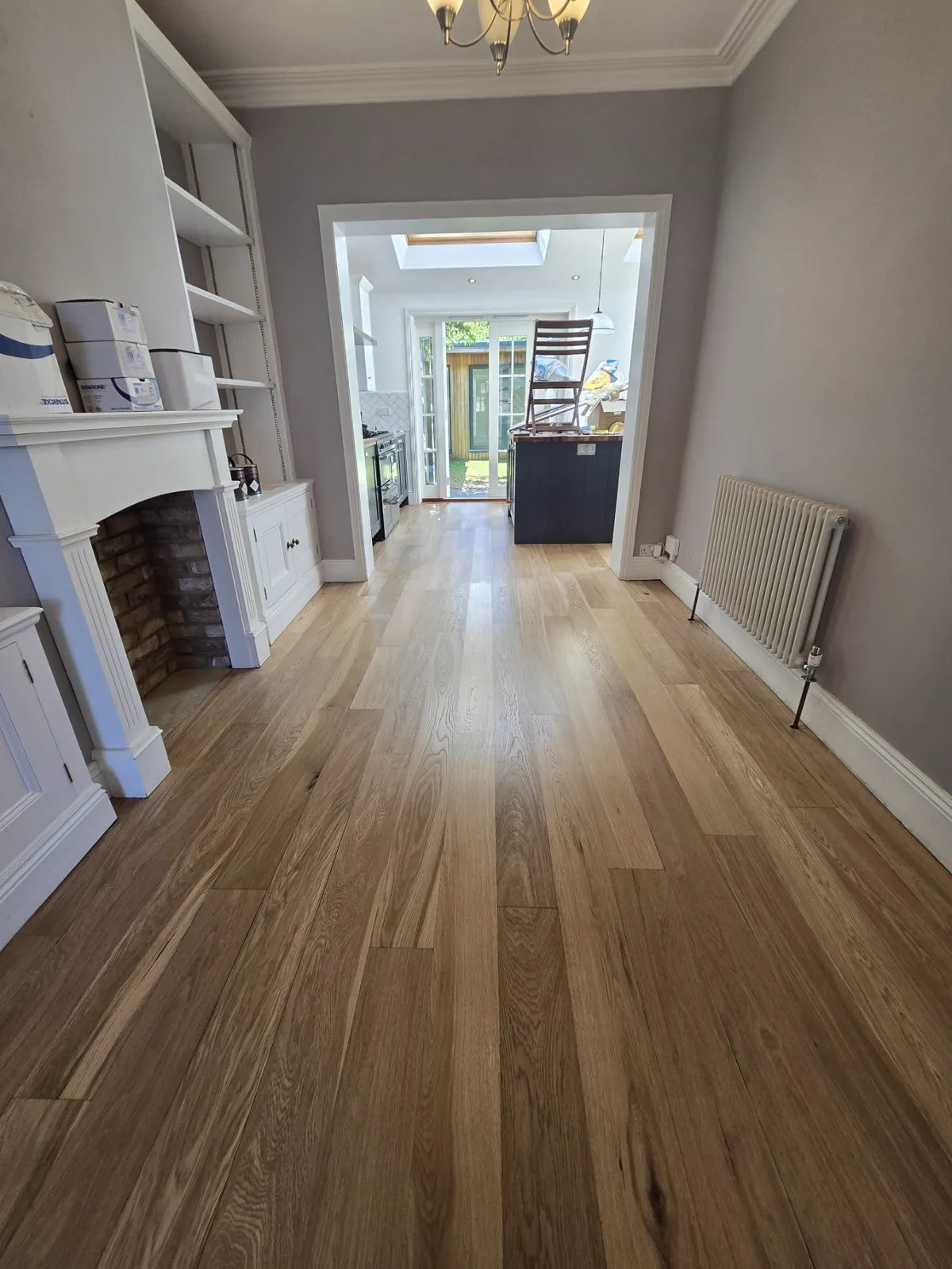
After the final sand, we spray a minimal amount of water onto the floor whilst mopping and drying simultaneously. This opens up the tight grain of the oak, allowing the stain to penetrate deeply and evenly.
Without water popping, oak resists stain absorption. You end up with a patchy, uneven colour that looks amateur. With it, you get a rich, consistent tone that shows off the grain.
We use LOBA Procolor stains, which are German-engineered and come in over 15 colours including Antique Oak, Chalk, Smoked Oak, Walnut, Wenge, Ebony, and many more. We always bring sample swatches to your home so you can see the colour on your actual floor before we commit.
Denibbing: The Secret to a Perfect Lacquer Finish
After staining (or on a natural floor), we apply the lacquer or oil finish. Between the first and second coats of lacquer, we do something called denibbing.
We fit a 200 grit wire mesh pad to our buffing machine and run it across the entire floor. This knocks off any tiny nibs, dust particles, or raised grain that settled into the first coat. Then we vacuum thoroughly and apply the next coat.
This is why a professionally finished floor feels completely smooth, while a DIY lacquer job always feels slightly rough or gritty. Denibbing between every coat is what makes the difference.
How Long Does Hardwood Floor Sanding Take?
A typical oak floor sanding job takes 1-2 days for sanding, plus drying time between finish coats. Most rooms can be sanded in a single day, with lacquer or oil applied over the following 1-2 days. Staining adds roughly half a day.
For larger projects, open-plan living spaces, hallway-through-to-kitchen runs, or commercial floors, we'll give you a clear timeline during our site visit.
How Much Does Oak Floor Sanding Cost?
Hardwood floor sanding typically costs £30-50 per square metre, depending on the size of the area (large areas earn a discount), the condition of the floor, the finish required, and any repairs needed. Staining is quoted on top of the sanding price.
We always provide a free, no-obligation quote after a site visit. We'll assess the floor, discuss your options for colour and finish, and give you a clear price with no hidden extras.
Why Choose Howard Naish?
We're not the cheapest, and we never will be. But here's what you get:
- 22 years of hands-on experience: Dean has been sanding floors since he was 17
- One of us, Dean or Luke, on every job, alongside the same small team we have worked with for years
- 4.9-star Google rating across 53 reviews
- All our own professional equipment: Lagler Hummel, Lagler Flip, four-pad machine
- Public liability insurance, certificate on request, and you can find us on Checkatrade
- Genuine care for your home: our customers call us friends by the end of every job
Most of our work comes through personal recommendation. We win quotes even when we're more expensive than competitors, because people can see the difference in quality and trust.
Whether you're in Balham, Clapham, Wandsworth, Dulwich, or anywhere else across South London, we'd love to take a look at your floor.
Call us: 020 3131 0122
Email: [email protected]
Or book a free site visit. We'll come to you, assess the floor, show you stain colour options if you're interested, and give you a clear, honest quote.
Choosing between oil and lacquer for your own oak? Our Oil or Lacquer guide gives the honest trade view, and the cost guide shows what a sand like this comes to.